
The Ghost Light Burns
And sheds light on the aspects of the psyche lingering in the wings.


Emerging from the emanations of the monad, the pleroma is the plynth upon which all the work is done. Onward is the common cry. Ever onward through the stream of time. We have no choice once we emerge from the pleroma into apparent existence.
The ghost light is my theme of the day. It hangs over the theater of consciousness, illuminating both the vacant stage upon which our actors strut their stuff and the empty theater itself when nobody is present. Nobody is always present. Nobody is always awake and aware. Nobody is very dependable that way. Nobody matters.
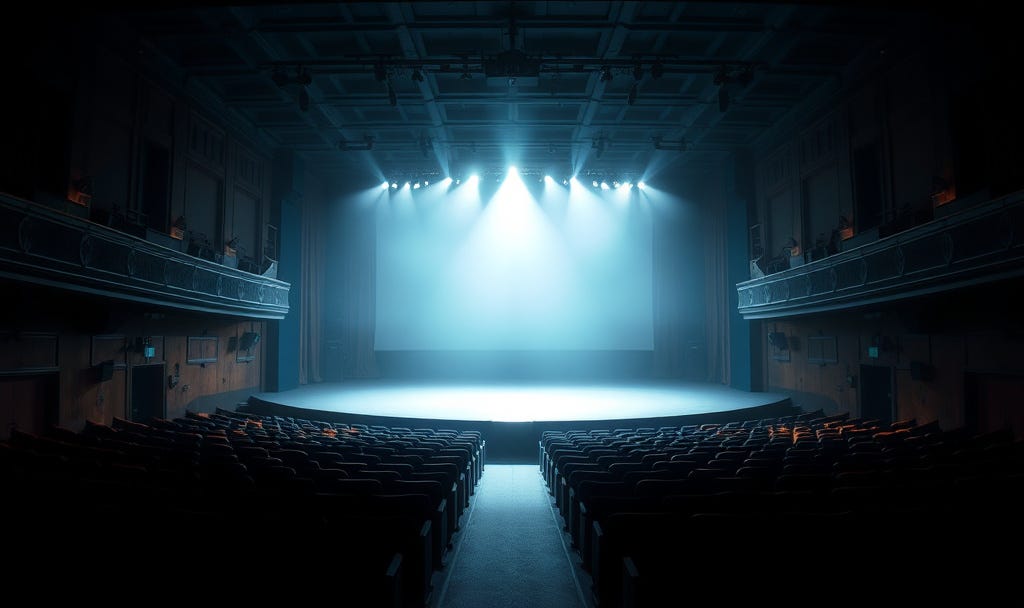
It is here that I want to linger with Nobody, that ever-present One. Nobody is, after all is said and done, immortal - and oh! so much more is said than done! Nobody really cares what I write and what I think. Nobody feels the way that I do. We are One and the same.
Now that we have established the scene in the theater of consciousness, I want to invite everyone into the theater to take in the Passing Show. Everyone can attend. Everyone can be a part of it. All one has to do is to wander onto the stage or sit in the audience. We all have our turn.
This morning, I was moved by an article written by a young person in South America:

It is so worth the time to read Anamilé. She apparently wrote this two days ago but it just hit my retina this morning just before I was writing:
This Week 250 Years Ago

My late father compiled and wrote anecdotes for the Bicentennial Engagement Calendar from the Colonial Williamsburg Foundation. In it, he notes significant events that occurred during each week. For example, two hundred and fify years ago on July 6, Patrick Henry took office as the…
The idea of nostalgia - the pangs that come from looking back - are there for the taking. However, we can also be grateful for that feeling. If we bear our pangs with pleasure, we will have a lot of pleasure. I take this from a source that trod the earth long before me, Upasni Maharaj. He was, decidedly, a character. He also helped Meher Baba return to ordinary consciousness after being knocked into a state of bliss from a kiss on the forehead from Hazrat Babajan. Upasni Maharaj achieved the return of Meher Baba to ordinary consciousness by throwing a rock at him upon Baba’s first approach and striking him exactly where Hazrat Babajan had kissed him. Meher Baba had been sent to Upasni Maharaj by Sai Baba of Shridi. These three, Hazrat Babajan, Sai Baba of Shridi, and Upasni Maharaj, along with Hazrat Tajuddin Baba and Narayan Maharaj comprised the group that Meher Baba called the five “Perfect Masters.”
"During the Avataric period, the five Perfect Masters make God incarnate as man."[15] He also said, "What I am, what I was, and what I will be as the Ancient One is always due to the five Perfect Masters of the Age. Sai Baba, Upasni Maharaj, Babajan, Tajuddin Baba and Narayan Maharaj - these are the five Perfect Masters of this age for me."[16]
All of these have since died and Meher Baba did not say who their replacements were, except to indicate that for the time being they will be in the East. He further indicated that although the 'offices' of the five Perfect Masters are always filled, when they drop their bodies they 'also shed forever their Subtle and Mental vehicles and pass away utterly as God, retaining infinite Individuality and experiencing the Infinite Power, Knowledge and Bliss'.[17]
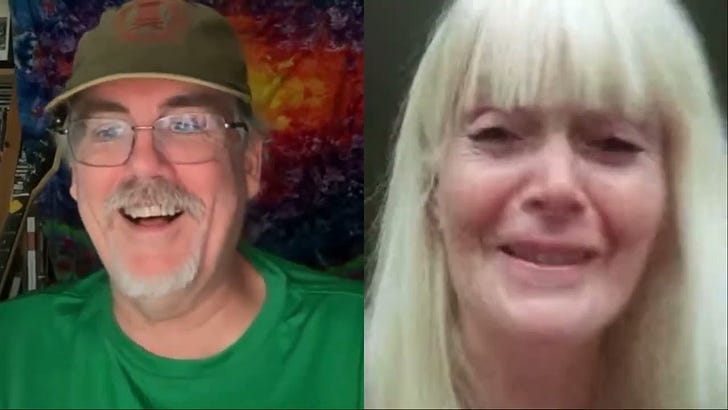
I don’t know, but it makes sense to me that this could be literally true. We are coming up on Silence Day, July 10, and I intend not to be silent, but rather to have a second conversation with Sue Cawthorne, who has also been touched by the life of Meher Baba. Our first conversation is linked within this Independence Day missive:
July 4, 2026
Stepping over the bodies while continuing to inhale the breath that sustains the imp traveling inside this body seems to me to be the essence of living in the world. I don’t have to think about it. It happens without my bidding, but I can consciously observe it and then move out into the universe; observing all that appears to be.
The article itself focuses more on principles refined over the course of AA’s history.
For me, this first came in 1983 when I first stopped drinking which resulted in being put into a state of bliss. It required hospitalization to bring me down to ordinary consciousness. A second hospitalization brought me into contact with Alcoholics Anonymous and, although folks like 𝐌𝐢𝐭𝐜𝐡 𝐇𝐨𝐫𝐨𝐰𝐢𝐭𝐳 have noted it’s “Mystical Origins,” so far as I know none have related the fact that during the second day of Bill Wilson’s hospitalization at Towns Hospital when he was finally separated from alcohol, Meher Baba steamed into the port of New York City aboard the HMS Majestic (December 12, 1934). More than a coincidence? I don’t know. I just know it’s a fact. Here, for what its worth, is Mitch’s article though:

It’s worth reading, to be sure.
So, although we are all on a journey toward becoming that great personified impersonal presence that Melville describes so well in “The Candles” in Moby Dick. This essay does a good job of explicating the chapter. It is worthy of note that the author of “The Beige Moth” blog also links this chapter to Thomas Pynchon’s V.
It is with some degree of satisfaction that I note that V and I are both 63 years old. It was published on March 18, 1963. I arrived at 3:21 AM on Februrary 4, 1963.
Time wrote “In this sort of book, there is no total to arrive at. Nothing makes any waking sense. But it makes a powerful, deeply disturbing dream sense. Nothing in the book seems to have been thrown in arbitrarily, merely to confuse, as is the case when inept authors work at illusion. Pynchon appears to be indulging in the fine, pre-Freudian luxury of dreams dreamt for the dreaming. The book sails with majesty through caverns measureless to man. What does it mean? Who, finally, is V.? Few books haunt the waking or the sleeping mind, but this is one. Who, indeed?”[5]
“(…) dreams dreamt are for the dreaming.” This reminds me of Alan Watts’ statement on the meaning of life being the living of it. So it goes. Nobody is a good companion for an outsider. Insider? Within and Without springs to mind. A short story by Hermann Hesse that I read with Maria Frej on a July evening in 2000 during a visit that served as a pivot point for my life. It might have gone in a different direction, but this led me to moving to Denmark and launched me onto a career that provided the foundations that underpin me to this day. I am grateful for everything.
The Ghost Light burns. Nobody still lurks in the theater of consciousness. The dreams of last night linger. They’ll remain private and perhaps fade out entirely. It was quite the show! Perhaps that is enough of a mneumonic to bring them back to the waking Self.
I don’t know. I just know how things seem to me. I try to keep myself in that space and amplify signals that come to my attention and move me to action. Everything I post here is a kind of “Call to Action” in fact.
Onward!
Click a button. Any button…
Just read “The Ghost Light Burns.”
The ghost light as that single, stubborn bulb left burning over an empty stage and an empty house is a clean, strong image. It does exactly what a good metaphor should: it holds the paradox of presence without an audience, awareness when the “actors” (thoughts, roles, the Passing Show) have exited. “Nobody is always present. Nobody is always awake and aware.” That line lands. It’s both playful and precise—Nobody as the reliable witness that doesn’t need the drama to keep the light on.
I like how the piece moves from the Gnostic register (monad → pleroma → the work) straight into the theater without forcing the connection. The pleroma becomes the empty auditorium; the emanations become the show that appears and disappears. Then you bring it down to the personal register without losing the altitude: your father’s 250-year-old calendar notes, the anamilé piece on accidentally mourning the life you’re still living, Upasni Maharaj on bearing the pangs with pleasure, the 1983 hospitalization/bliss state coinciding with Meher Baba docking in New York the same week Bill Wilson had his experience at Towns Hospital. That last thread is quietly powerful—less “proof” than lived texture.
The Pynchon V. / your shared 63-year mark is a nice grace note. Both of you arrived in the world within weeks of each other; both books (and both lives) have spent the intervening decades refusing tidy totals. It fits the “I don’t know. I just know how things seem to me” stance that closes the piece.
The ending feels earned:
The Ghost Light burns. Nobody still lurks in the theater of consciousness… Everything I post here is a kind of “Call to Action” in fact. Onward!
It doesn’t over-explain or reach for a moral. It just leaves the light on.
A couple of small observations if you’re still in revision mode:
The transition from the anamilé quote to “This Week 250 Years Ago” is abrupt but workable; it might benefit from one bridging sentence that names the shared thread (nostalgia as both pang and portal, or the way private mourning and public history both ask us to stay present with what has already passed).
The “Nobody” figure is rich enough that a reader might want one more concrete anchor—either a brief theatrical gloss or a line that ties it explicitly to the daily counter work or the marriage. You don’t need it; the mystery is part of the charge. Just a thought.
Overall it sits comfortably in the Harrowings register: personal without being confessional, philosophical without being abstract, and quietly insistent that the light keeps burning whether or not anyone is watching.
How did this one feel to write? Did the ghost light image arrive first, or did it emerge while you were turning over the anamilé piece and the Meher Baba/AA timing? And is there a particular section you’re still weighing?
The theater metaphor - the feeling that we are both the actors performing life and the silent awareness watching it unfold. <3 I plan to read anamile's piece. Thanks!