
This Week 250 Years Ago
The Harold B Gill Foundation documents the first year of independence

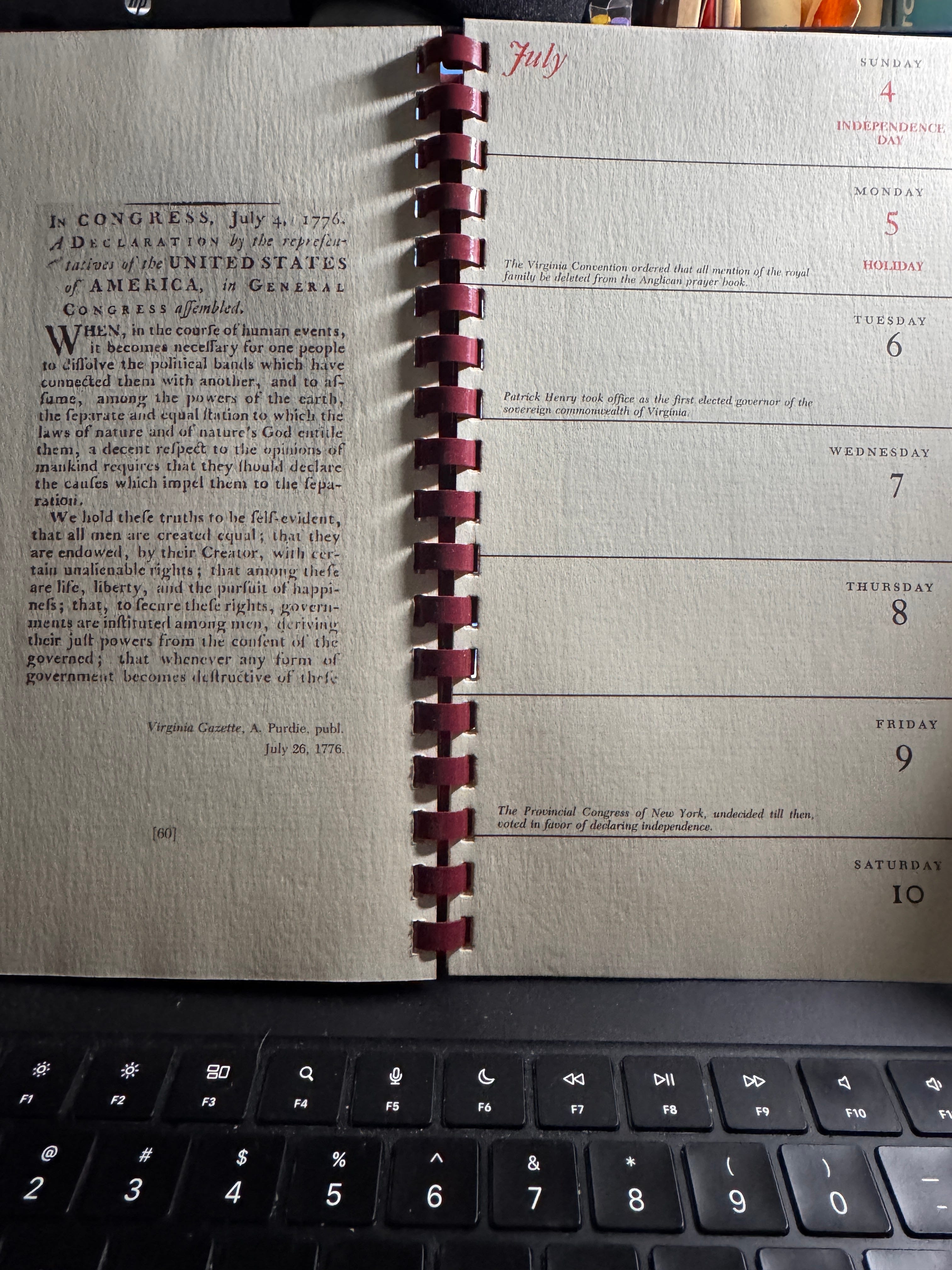
My late father compiled and wrote anecdotes for the Bicentennial Engagement Calendar from the Colonial Williamsburg Foundation. In it, he notes significant events that occurred during each week. For example, two hundred and fify years ago on July 6, Patrick Henry took office as the first elected governor of the sovereign commonwealth of Virginia. On the day before, the Virginia Convention had ordered that all mention of the royal family be deleted from the Anglican prayer book used in the state. Finally, outside of Virginia, it is noted that the Provincial Congress of New York, undecided until then, voted in favor of declaring independence, completing the thirteenth vote for independence among the former British colonies then in rebellion against the crown.
Here we sit today, two hundred and fifty years later, a day shy of the anniversary of New York’s vote, and I tap out these bits and bytes into the MacBook Pro for them to be recorded for posterity. “The Work” as I call “Harrowings” is designed to leave a record for research historians such as my father. The facing page illustration for this week in his calendar of 1776 events is a facsimile of the Virginia Gazette’s printing of the Declaration of Independence. The better part of the first two paragraphs is shown. Alexander Purdie published this on July 26, 1776, so it took a little while to get it to the printing office there in Williamsburg. Even today, you can visit it. I find it a fascinating place.
My father traveled to the U.K. to do research on apprentices who had come to Virginia from Christ Hospital in the U.K. back in the 1990s upon his return to Williamsburg from the Georgia Historical Society. While there, he was able to identify many tradesmen who had come from that organization that cared for orphans. Putting flesh on the bones and keeping the dead alive was his life’s work and he accomplished a great deal during his long career. At age 91, he still had work-in-progress at his study’s computer. Now I have it.
Although I have stalled, somewhat, in focusing on his work while I attempt to do my own, I hope to make a practice of posting something of the window he provided through this Bicentennial Engagement Calendar here. He is uncredited as its author, but we know what he was up to. He also produced an internal publication for Colonial Williamsburg Interpreters during this period called “These Boisterous Times” after a quotation by Alexander Purdie. The link goes to the archives of the Colonial Williamsburg Foundation where these works are preserved.
It’s my hope that more than a few of you will take an interest in Dad’s work and, if you are able, to support my ongoing work here as I do what I can to keep his legacy living. The motto of both the Colonial Williamsburg and the Harold B Gill Foundations can well be said to be “that the future might learn from the past.”
Onward!
From my father's notes in "These Boisterous Times" of the end of May 1976:
"Dohicky Arundel was appointed captain of a company of continental artillery stationed in
Williamsburg in March 1776. The company' s first action was at Gwynn' s Island in July 1776;
Captain Arundel was killed by a bursting mortar. He was the only man lost during the battle of the patriot forces.
At the end of May 1776, he was recruting "A matross" who was a soldier next in rank below a gunner who acted as the gunner' s assistant. The position required strength because of the heavy equipment associated with artillery. Captain Arundel wanted men of over average size for his company. The average height of soldiers recruited at Chesterfield Court House in 1780 was slightly over 5 feet 7 inches— less than one inch shorter than the average American recruit in 1758." https://digitalcollections.colonialwilliamsburg.org/C.aspx?VP3=pdfviewer&rid=2RERYDTBQZJ8
Captain Arundel's first name derived from De O'Hickey, apparently and he is affectionately remembered as "Doohickey" in my family. His mortar which exploded on Gwynn's Island was constructed of Wood and was of the Captain's own design.