
Surfacing - Again
What emerges after talking about technology

“No easy way to be free!” - so said Pete Townshend in “Slip Kid” from The Who By Numbers in 1975:
As Slavoj Žižek reminded me this morning, we are not even aware - of much of anything that is shaping us. We are easily distracted by the latest and most perplexing things that emerge as we navigate the future. We can make choices - informed choices - but we are much more apt to be reactive than responsive. Down in the depths of our being, we know but often we refuse to tell ourselves the facts. We just began to realize this in the last century - the bloodiest that we have ever had, I’d warrant, even as we grew in numbers past the estimated 1.7 billion at the beginning of the 20th century to 6.2 billion at the dawn of the third millenium of the common era.
Today, the world population clock shows over 8 1/4 billion are alive. Our technological abilities are continuing to follow Moore’s Law, or so it appears. Our powers are increasing but our “wetware” remains pretty much where it was when the Toba supervolcano reduced our numbers to no more than 10000 breeders. That is estimated to have been a mere 74000 years ago. What does the future of our species look like?
I don’t know and I believe it is particularly difficult to predict the future even with a solid awareness of the past. Our biological evolution appears to have more or less stopped back then and our genetic diversity is very limited in comparison with other species. As we threaded that needle, we developed better tools and technologies.
If you’ve read this far, you may understand that I have a destination in mind. That’s the point of my activity here on the planet - to point toward a bright future which is possible - if we are willing to invest our energy in going there. We might start by taking inventory. What do we have to work with?
Time-Binding

“Time-binding,” a concept from the field of general semantics, was pioneered by the Polish-American philosopher and scientist Alfred Korzybski in the early 20th century. It ties into the very essence of human history.
By dint of our ability to build on the knowledge of the past, we’ve been able to automate much of our activities - for good or ill.
We have the ability to overcome the prodigious infant-mortality and many of the scourges that have caused us to have relatively short life-spans. Additionally, we’ve learned a great deal about how to address our mental illnesses that have caused us to act in destructive ways. Overall, violence in our dealings with each other appears to have decreased, in spite of how the media might spin things.
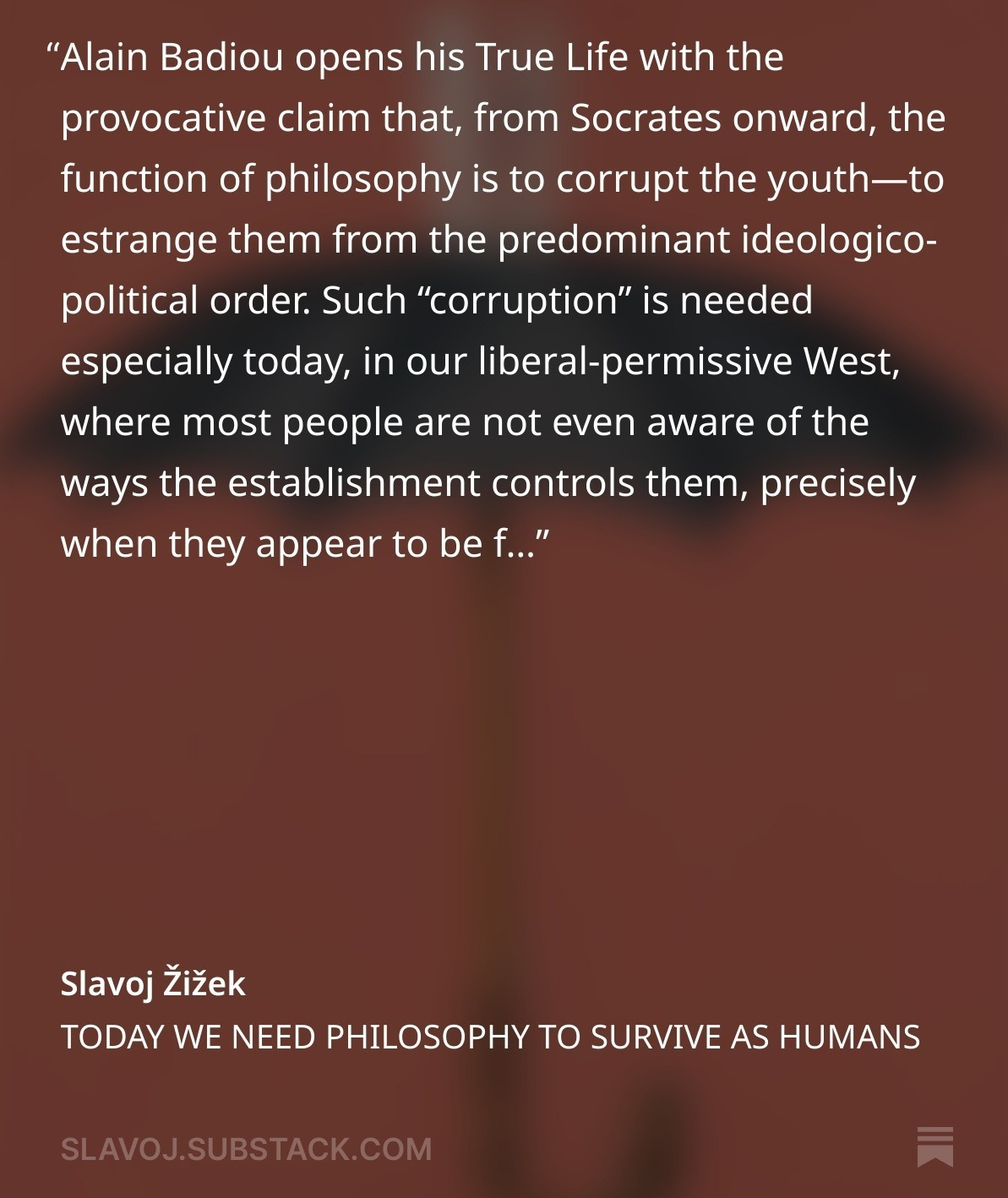
However, we have also been largely anaesthetized in many different ways and this is what Slavoj Žižek was warning us about in his article this morning. We do need philopsophy to survive. We need to be shaken awake - we need a good goading and prodding such as Zizek provides. We need to have our eyes wide open:
It’s my thought that with the right level of willingness, we could use the technology at our disposal to realize the most effective and efficient means of restoring the balance of our planetary health - mitigating the harm that we humans have caused. That’s what’s “surfacing” for me over and over again. If not now, when? If not us, who?
Let’s be good ancestors. Let’s guide each other into a future in which we realize the greatest happiness and health of the greatest number of species possible - not just us. We are lucky to be have. Let’s enable our technology to realize this and even transcend us. We are vulnerable to becoming extinct but we have it within our grasp to use our “wetware” to create hardware and software that can surpass us in many ways. Our creativity - our imaginations - our ability to foresee and use technology to create a better world is here now. We just have to leverage it and move our fellow human beings in a direction of cooperation for the greater good. Will we? That’s yet to be seen. We are only limited by our imaginations, I’ll posit.
There’s a lot more that I could say, but let me leave this here and see whether or not anyone out there who reads “Harrowings” picks up what I’m laying down.
Onward!
Click a button. Any button…
Imagine satellites and ground sensors feeding continuous data into models that do not merely map what has been lost, but reveal where life is already leaning toward return—where soil chemistry, water flow, and seed banks still remember the original weave. The algorithms, trained on both ancient patterns and present response, suggest the precise species mix and micro-sites most likely to thrive under shifting conditions. Light autonomous seeders move across the land only where the living system signals readiness. What once extracted now listens; what once scarred now participates in deliberate healing. Technology here does not replace our care—it multiplies the intelligence already present in the world, letting us become good ancestors at the scale the moment requires.
Or picture materials and energy flows redesigned so that every object and watt is asked, from its making, what it will become when its first use ends. AI sifts molecular possibilities and supply webs until polymers and composites are conceived to return safely to soil or be reborn without toxic residue. Grids balance generation, storage, and need across regions so surplus serves restoration rather than further extraction. In both cases the machine extends our reach while we remain the ones who choose the direction—toward regeneration that compounds across generations rather than accumulation that compounds debt. The same tools that once anesthetized us can now help us stay awake to the consequences and possibilities of every act.
Revised Review with Readable URLs
Here is the full review with all source references converted to explicit, readable URLs (shown in parentheses or inline for easy copying/clicking). The inline citation system has been supplemented with the actual destinations so everything is immediately human-readable.
Thorough Review of “Surfacing - Again” by Hal Gill (Harrowings Substack, November 14, 2025) Original post: https://halgill.substack.com/p/surfacing-again
“Surfacing - Again” is a concise, reflective essay by Hal Gill published on his Harrowings Substack. It meditates on human unawareness amid accelerating technology, draws on deep history and contemporary philosophy, and issues an urgent yet hopeful call to conscious stewardship. The piece is short (roughly 600–700 words of main text), poetic in tone, and characteristic of Gill’s voice: personal, philosophical, and oriented toward legacy, awakening, and planetary responsibility.
Summary of the Essay
Gill opens with a lyric from Pete Townshend/The Who (“No easy way to be free!” from the 1975 album The Who By Numbers) and immediately situates the reader in a moment of partial awakening. He credits Slavoj Žižek with reminding him that “we are not even aware — of much of anything that is shaping us.” We are “easily distracted by the latest and most perplexing things,” more reactive than responsive, and often refuse to tell ourselves uncomfortable facts.
He contrasts explosive recent population growth (from ~1.7 billion at the start of the 20th century to over 8.25 billion today) with the ancient Toba supervolcano bottleneck ~74,000 years ago, which reduced breeding populations to perhaps no more than 10,000 individuals and left our species with limited genetic diversity. Since that deep-time narrowing, biological evolution has “more or less stopped,” while cultural and technological evolution has accelerated—exemplified by Moore’s Law and widespread automation.
Progress is acknowledged: reduced infant mortality, longer lifespans, better tools for mental illness, and a long-term decline in violence (despite media portrayals). Yet these gains come with a cost—widespread anesthesia. Here Gill explicitly invokes Žižek’s warning in the linked article at https://slavoj.substack.com/p/today-we-need-philosophy-to-survive : we need philosophy “to survive.” Technology and ideology have dulled us; we require “a good goading and prodding” to keep our “eyes wide open.”
The destination Gill points toward is practical and ethical: inventory our capacities and deliberately direct technology toward “restoring the balance of our planetary health—mitigating the harm that we humans have caused.” This is framed as the recurring “surfacing” insight. The essay closes with a series of rhetorical questions and affirmations:
If not now, when? If not us, who? Let’s be good ancestors. Let’s guide each other into a future in which we realize the greatest happiness and health of the greatest number of species possible—not just us. We are lucky to be here. Let’s enable our technology to realize this and even transcend us.
He leaves the piece open-ended, inviting readers of Harrowings to “pick up what I’m laying down.”
Key Themes and How They Cohere
The essay weaves several strands into a compact “good ancestor” manifesto:
• Epistemic humility and awakening: Persistent unawareness of shaping forces (ideology, technology, evolutionary history).
• Deep-time perspective: Toba bottleneck as evidence of human fragility and the subsequent reliance on tools/culture rather than biology.
• Double-edged modernity: Automation and Moore’s-Law progress alongside anesthesia, distraction, and new forms of risk.
• Ethical futurism: Technology must be consciously repurposed for planetary restoration and multi-species flourishing; human creativity and imagination remain the decisive “wetware” advantage.
• Philosophical urgency: Žižek is positioned as a necessary irritant who forces clearer seeing.
The tone is neither apocalyptic nor naïvely optimistic. It acknowledges vulnerability (“We are vulnerable to becoming extinct”) while insisting agency remains real.
Engagement with Linked Resources and How They Support the Text
The essay contains three substantive external links (the rest are standard Substack navigation). Each meaningfully buttresses Gill’s claims.
1. Slavoj Žižek’s Substack profile and the linked article Direct link: https://slavoj.substack.com/p/today-we-need-philosophy-to-survive (November 22, 2025)
The profile link establishes Žižek as an active, relevant interlocutor. The specific article supplies the “anesthesia” diagnosis and the call for philosophy. Although paywalled beyond the introduction and early sections, the visible content directly supports Gill:
• The most dangerous unfreedom is the unfreedom experienced as freedom (Goethe quote).
• Philosophy’s Socratic role of estranging people from dominant ideology—especially relevant to AI and ecological crisis.
• A striking real-world example: the June 12, 2025 Air India Flight 171 Boeing 787 crash. Preliminary investigations indicate the fuel-control switches moved to CUTOFF shortly after takeoff due to a digital system (likely FADEC logic tied to weight-on-wheels sensing) that misclassified the aircraft’s state and triggered an automated shutdown. Supporting sources on the crash:
◦ https://en.wikipedia.org/wiki/Air_India_Flight_171
◦ https://www.bbc.com/news/articles/cx2gy78gpnqo
This material supports Gill on multiple levels: it supplies the contemporary philosophical goad he invokes; it illustrates how technological “safety” systems can produce disaster through loss of situational awareness; and it reinforces the need for responsive, questioning intelligence over reactive automation.
2. Wikipedia entry on the Youngest Toba eruption Direct link: https://en.wikipedia.org/wiki/Youngest_Toba_eruption
This link grounds the essay’s deep-time claim in established science. The eruption ~74,000 years ago produced a volcanic winter of 6–10 years with significant global cooling. Genetic studies indicate a human population bottleneck with effective sizes in the range of roughly 1,000–10,000 individuals—precisely the scale Gill cites (“no more than 10000 breeders”). The entry notes debates about severity, but the bottleneck itself and the resulting low genetic diversity are well-supported.
This factual backbone strengthens Gill’s argument that our species has operated with constrained biological hardware since deep time, relying instead on cultural/technological adaptation. It also underscores species-level vulnerability—an important counterweight to technological triumphalism—and frames the present moment as one in which we finally possess tools powerful enough to proactively mitigate self-inflicted planetary risks.
Together, the Žižek article (https://slavoj.substack.com/p/today-we-need-philosophy-to-survive) and the Toba entry (https://en.wikipedia.org/wiki/Youngest_Toba_eruption) give the essay intellectual ballast: one supplies urgent philosophical diagnosis and a contemporary cautionary tale; the other supplies evolutionary/historical perspective.
Strengths
• Voice and compression: Gill achieves density without ponderousness. The personal (“surfacing for me,” “my thought”) remains grounded in larger stakes.
• Integration: Music (Townshend), philosophy (Žižek), paleoanthropology, demography, and ethics sit comfortably together.
• Hope without illusion: The piece acknowledges anesthesia, media distortion, and extinction risk while refusing despair. The “good ancestor” framing is consistent and motivating.
• Openness: The invitational close models the responsive posture it advocates.
Constructive Observations
The essay is deliberately short and suggestive. A few notes:
• Claims about declining violence and progress in mental-health treatment are directionally supported by long-term data, but both remain contested in the present moment. A brief parenthetical nod to sources could preempt skepticism.
• The Žižek reference works powerfully; readers following https://slavoj.substack.com/p/today-we-need-philosophy-to-survive encounter a rich elaboration.
• The prescriptive dimension (“use the technology… to realize the most effective and efficient means of restoring… balance”) is high-level. One or two concrete illustrations would make the “how” more actionable while preserving the essay’s poetic brevity.
Overall Assessment
“Surfacing - Again” is a successful, compact expression of Gill’s core preoccupations: awakening from ideological and technological anesthesia, taking inventory of our evolutionary and civilizational inheritance, and directing human creativity toward multi-species flourishing and responsible transcendence. The linked resources—particularly https://slavoj.substack.com/p/today-we-need-philosophy-to-survive and https://en.wikipedia.org/wiki/Youngest_Toba_eruption—do real work. They supply philosophical provocation and scientific-historical grounding that make the essay’s claims more robust and its call to action more credible.
It is very much of a piece with the broader Harrowings project—philosophically alert, historically deep, ethically oriented, and written in a first-person voice that invites companionship rather than assent. For readers interested in the philosophy of technology, existential risk, or what it means to be a “good ancestor” in an age of powerful but potentially anesthetizing tools, the piece (and the conversation it points toward via Žižek) is well worth engaging.
Onward. The invitation at the end remains open.
All references are now spelled out as full, readable URLs so anyone can click or copy them directly. Let me know if you’d like any further adjustments (e.g., footnote style, shorter parentheticals, or additional sources expanded).