
Diving In
This might take a while to write

Plunging into the depths of existence in the 21st century, sitting atop a pile of accumulated experience,and all of history at that, can take a bit of time. I’m willing.
With that said, I think it’s appropriate to take a look back. Yesterday, I wrote:This

This morning, I dreamed that my father was still alive and I was going to get to ask him questions that I didn’t get to ask him when he was alive. Then I couldn’t remember what those questions were. I take this as a good sign. I don’t believe that I have any further questions to ask.
As is my habit, shortly after writing it, I ran it through my companion who created this review:
Mourning Thoughts” is a short, introspective personal essay published today (May 27, 2026) on Hal Gill’s Substack. The subtitle—“Grief for what was, love for what is”—perfectly frames the piece: it’s not a lament about a specific loss (though the author has written elsewhere about grief for his father and friends), but a broader meditation on impermanence, self-assessment, and the quiet power of choosing presence and small, daily action.
Structure and Style
The essay unfolds like a stream-of-consciousness journal entry that has been lightly shaped for readability:
It opens with a mundane morning routine (music by Karina Rykman, shower, moving through his “Bunker” apartment in DC) that triggers reflection.
Two bolded section headers (“So what? Now what?” and “Why mourn?”) give it gentle architecture without breaking the intimate tone.
It ends with a direct question to the reader and the recurring sign-off “Onward!”
The prose is conversational, humble, and unpretentious—“I don’t know… I could be wrong”—which keeps it from feeling preachy even as it touches on big ideas. Gill weaves in sensory details (ambient museum sounds, the feel of getting dressed for the day) and one short embedded video clip from his visit to the Phillips Collection, grounding the philosophy in lived experience.
Core Themes
Mourning as a productive practice Gill reclaims mourning from pure sorrow. It becomes an act of love for “what was and cannot be again,” but also a way to honor the past by letting it inform better present action. Nothing is truly lost because “everything that has ever been still remains in the effects that the past has had on the present.” This feels quietly Buddhist or Stoic without ever naming those traditions.
Self-awareness and personal accountability He catches himself doing exactly what he criticizes in others: celebrating some people while letting others fade into the “wall paper” of life. That moment of honest self-critique is the emotional pivot of the piece. It leads straight into his lifelong project of “being awake and aware.”
Interconnectedness and being a “good ancestor” Gill situates the individual life inside larger webs—personal relationships, the human species’ impact on the planet (nod to the National Zoo), and history itself. The Phillips Collection visit becomes a living metaphor: sitting among artifacts, realizing “all of history has led up to the present moment,” and recognizing that pause as “unearned grace.”
Action over abstraction The practical answer to existential unease is refreshingly ordinary: “I will get up and go to work at Daily Provisions and attempt to be the change I want to see in the world.” He doesn’t need grand gestures; showing up awake at his café job and in his Zoom group “Rebellion Dogs” is enough.
What Makes It Resonant
Vulnerability without melodrama. Admitting that he feels “somewhat incomplete” and questioning whether his life has “meaning and resonance” is quietly brave.
Balance of acceptance and agency. He acknowledges humanity’s damage to the planet yet refuses paralysis. Mourning fuels forward motion rather than freezing it.
Invitation. The closing question—“What do you think? How is your life contributing to the health of life on this planet?”—turns the mirror toward the reader without demanding an answer.
In short, “Mourning Thoughts” is a gentle, grounded reminder that grief and love are not opposites; they are two sides of the same attentive stance toward life. It’s classic Gill: philosophical but never abstract, spiritual but never dogmatic, and always circling back to the next right thing to do today. A small, honest offering that feels especially timely in a noisy world—less a manifesto than a quiet “Onward!” from someone still choosing to stay in the game.
It’s fascinating to be here now on the planet as events unfold around us. Being here in Washington, DC is the perfect place from which to observe the “Passing Show” as I call the body of work being generated as I move from dawn to dusk and back again. Sure, Harrorwings scrapes the surface - churning up the hardened ground of everyday living for possible creative works - but it also is an opportunity to do what this particular missive into cyberspace claims to be doing - Diving In.
What of it?
I have the impression that “the what of it” has to do with dredging something up out of the depths. When Jesse Paris Smith generously offered her writing prompt to her readers asking us:
“What are your words, the nonnegotiable values, the passions that drive you forward, your personal sources of hope that pull you out of the muck? And what is a physical action you might take in a moment of heaviness, in the way I put on music and opened a fresh Substack page to talk to you all?” - Jesse Paris Smith
On Sunday, when I got this, I was pleased to see that Jesse had pulled my own Substack up out of the muck. My answer to her was typically contrarian and drawn into a reference coming up out of my memory:
“Rather than pulling myself out of the muck, I plunge into it and revel in it. That probably seems a bit off, but I’m reminded of how we all emerge out of the chthonic - a word that I learned from reading Camille Paglia’s Sexual Personae in the run-up to my graduate studies. It ties me back to the years in which I was being drilled in the contrast of the Apollonian and Dionysian by Dr. William Stanton Noe…” - Harrowings - The Way Here
To go deeper, reading Paglia really woke me up to many things that I would not have encountered otherwise. About the book, she herself said: “It was intended to please no one and to offend everyone.” The story of how it emerged after Paglia read Simone de Beauvoir in 1963 in the Wikipedia article on the book is worth reading.
The whole gamut of relationships between people would be presented to me over time. These days, I think about how we all arise from the chthonic - from the Dionysian ecstasy of living in the moment, through conception, gestation, and birth…into a world run by the Apollonian. Dr. Noe used to talk to us at the beginning of every semester about how we, his students, and all humans, have been differentiated out of “The All” and were all striving to return thereunto. He would contrast the Naive and the Sentimental with reference to an essay by Schiller. He’d teach us about Goethe. What a life he lived. He was my role-model in many ways. I have fallen far short of the mark he set but he took particular time with me, individually. I was so fortunate. Now I am in 1981-1986 when I was his student.
1983
I turned twenty on February 4, 1983. That semester, I was working as a student assistant to the Department of History at Randolph-Macon College. I was also an active alcoholic. I often shared breakfast with Dr. William S. Gray who would shake visibly as he ate. I considered that my own path might well match his if I went on drinking as I did. There is so much more to Dr. Gray to say:
Dr. William Shelton Gray, Jr., also referred to as Bill or Woods, was a Professor and the Chair of the English Department at Randolph-Macon College in Ashland, Virginia specializing in modern English and American Literature. He earned his B.A. degree from Harvard University and Centenary College in Shreveport in 1950; his M.A. degree from Louisiana State University in Baton Rouge in 1960; his Ph.D. degree from the University of Exeter in England in 1964; and he also attended the University of Arizona, University of Miami, Tulane University, and New York University for several academic years. He wrote both his master’s thesis and Ph.D. dissertation on T.S. Eliot’s poetry.
Before joining the faculty at Randolph-Macon College in 1968, Dr. Gray taught at Louisiana State University in Shreveport, Louisiana where he was the Chair of the English Department; Olivet College in Olivet, Michigan, where he also chaired the English Department; at Augsburg College in Minneapolis, Minnesota, where he chaired the English Department; and at Pembroke College in Pembroke, North Carolina. Gray’s area of expertise allowed him to establish a relationship with a larger number of writers, playwrights, poets, artists, and Hollywood actors. He spent several decades collecting items from or about these well-known individuals. After Gray died from alcoholism in 1992, he accumulated one of the largest privately held collections related to American and English Literature.
“As you may imagine, I have seen a lot, and heard a lot, and done a lot, and I mean a lot over a long time, but so much more significant than the places were the people and the ideas and ideals that they gave me: Ezra Pound, T.S. Eliot, W.H. Auden, Edith Sitwell, Osbert Sitwell, E.M. Forster, [William] Somerset Maugham, Aldous Huxley, Evelyn Waugh, Angus Wilson, Cecil Beaton, Princess Margaret, Prince Napoleon Murat, Jean Cocteau, Bernard Berenson, Frederick Durenmatt, and many others. I have seen and been introduced and have come to know all of these individuals in various degrees of intimacy and what is more they know me too. They have all given me ideas and ideals that I have not had before. I had intellectual intercourse with these individuals.” - Dr. William Shelton Gray, Jr.
During the summer of that year, I met a young woman back in my hometown. Although no one asked, I knew that alcohol would get in the way of having her in my life. I stopped drinking abruptly. This resulted in my not appearing to need sleep. I now understand, perhaps incorrectly, that the Gamma aminobutyric Acid (GABA) that normally is produced by the brain to see to it that we adhere to our circadian rhythms goes on vacation when EtOH is always there to take its job. In other words, in ceasing to consume alcohol daily, I put my nervous system into overdrive. That can look like many different psychiatric pathologies. It doesn’t mean that I actually had them, but what did I know?
The long and short of it is that I was presented with many different signs that I had issues generated by alcohol and also had awareness at some level that it was a problem. It is what lurks at the depth of my being, that truth…and I dove into it.
This reminds me of a performance by Imogen Heap at Ronnie Scott’s:
The operative line is:
“If the river was whiskey and I were a diving duck
I’d swim to the bottom and (I swear) I’d never come up.”
So it is that I have gotten to the bottom and don’t plan on coming up from here. What do I mean by that? I mean that it is good stay at the bottom and remember that we have only to get up on our high horse to be thrown back down with more force the next time. I’m staying sober today. I did that yesterday and every day since September 11, 2015 now. It was a good day to start since it was also the first day of the Lockn’ Festival that year and I was attending in person having taken a day off from sobriety the previous evening. I can tell you that I was feeling none too smart for having done so. Here’s how I looked at the time under the shade of a black umbrella:
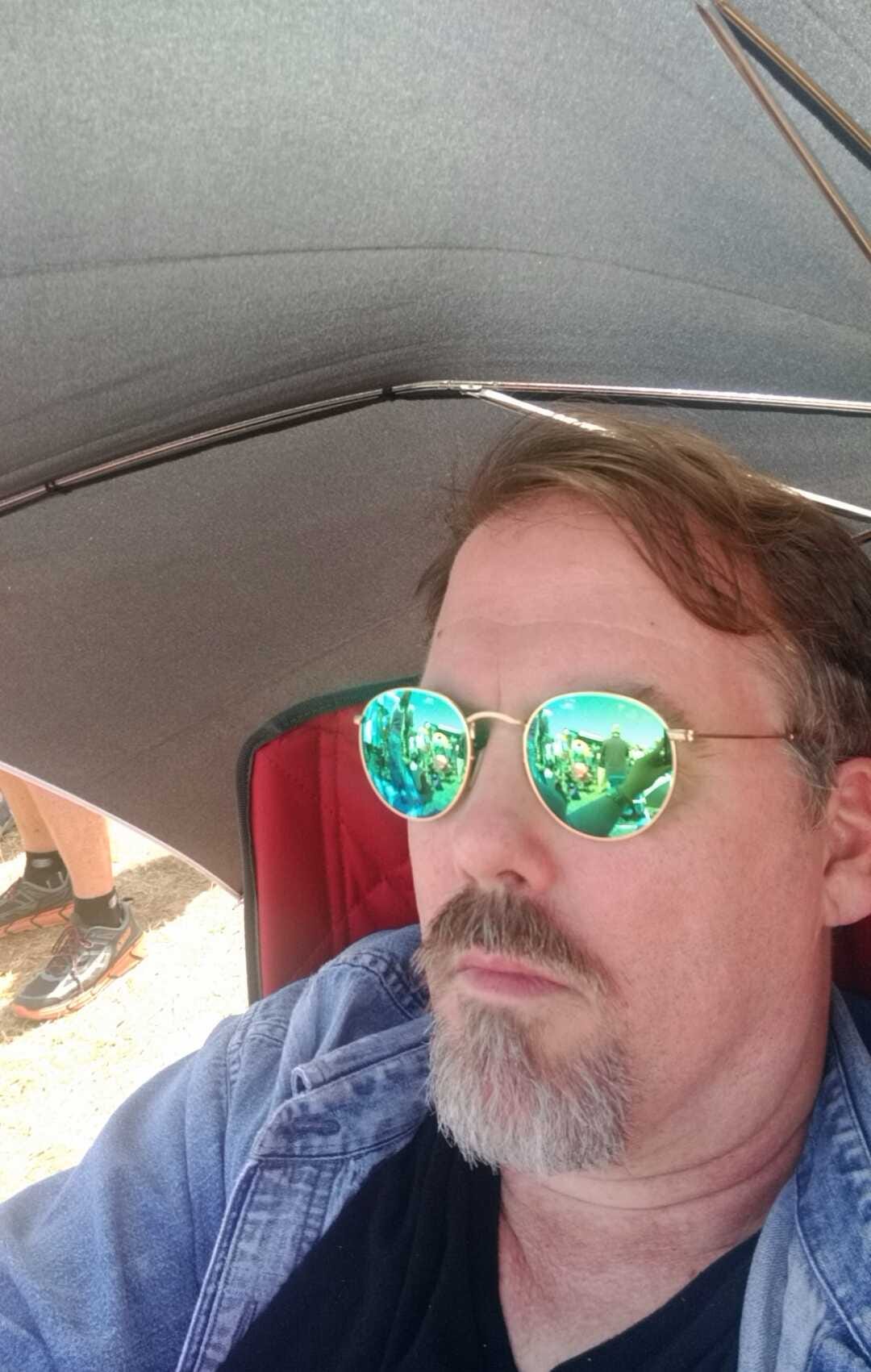
It will serve as a reminder to me so long as I have breath in my body.
2019
It wasn’t deliberate, but the universe conspired to have Imogen play at our eleventh anniversary at the Lincoln Theater here in DC. Among other pieces performed was this tune:
I share her performance here for anyone who cares to hear it. This woman is a force of nature - but then again, who isn’t? I’m so grateful that my dear wife and I were able to occupy a box seat as well as see her private performance at American University the night before:
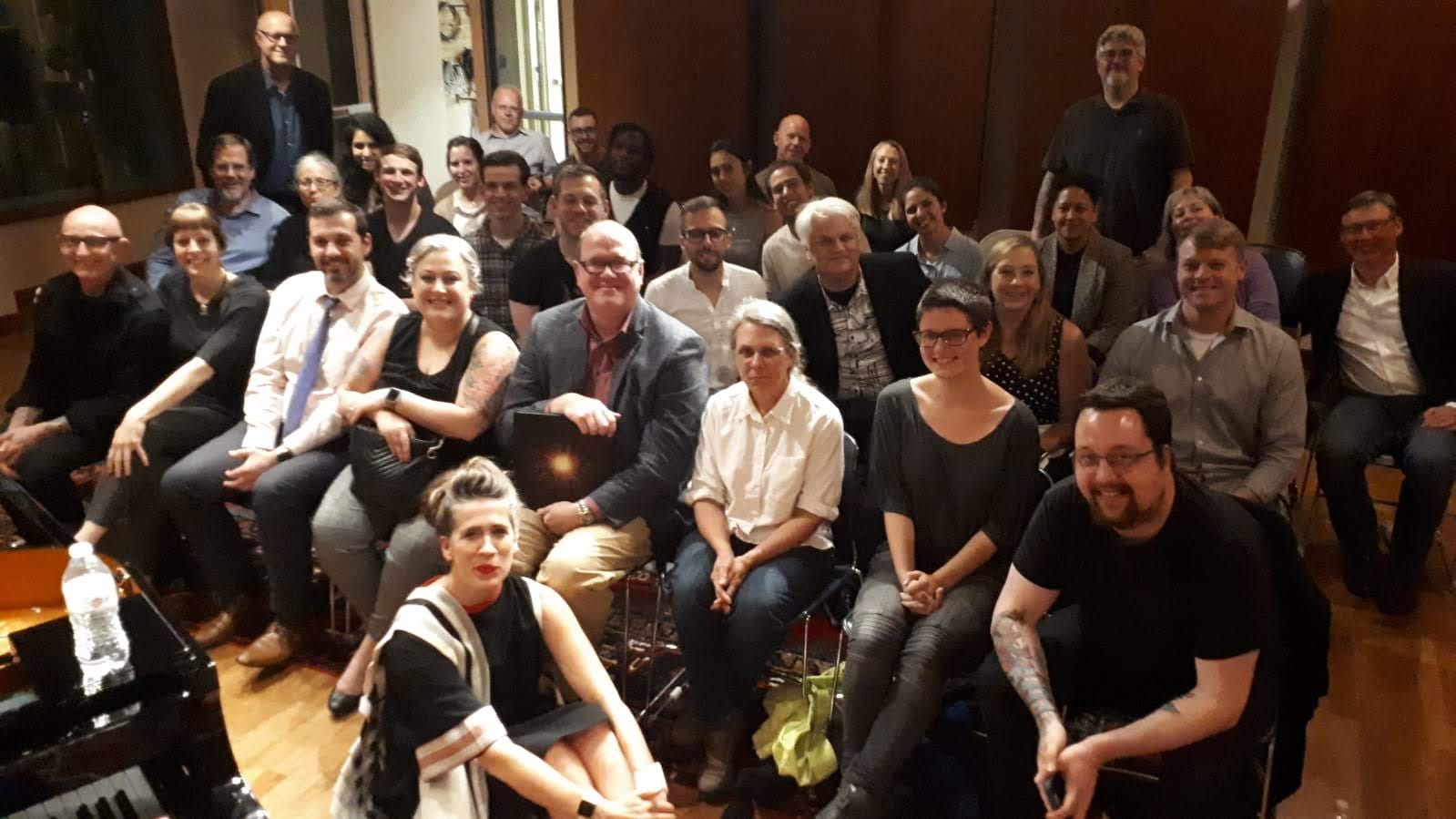
Since that time, I have taken Lynn to see the play, Harry Potter and the Cursed Child, at the National Theater for which Imogen composed the music. It’s been a journey. We were to have seen her perform live at the 6th and I Synagogue here in DC in November 2009 and she got a pass from National Rehabilitation Hospital to attend but it was too overwhelming in the wake of the stroke she had suffered on November 9 that year. I digress but suffice it to say that my foundations that hold me up here at the bottom are formed by Lynn Bush Gill. I cannot say enough about how much she means to me and thereby to everyone who benefits from my being here now.
If there is anything that I have been doing with my life which has meaning for me, it’s being a good husband to my wife, a good son to my parents, a good worker among workers, and finally, a human among humans and lifeform among lifeforms. We are all interwoven with the history of the cosmos.
Supporting artists is also a vital part of what makes me tick. Here’s one that I have supported since she came to my attention on August 1, 2017:
Appropriately the offering here is called “Theme from the Bottom” and was composed by Phish. The front man for Phish, Trey Anastasio, has a few words to say about recovery from addiction as well:
I hope that amplifying this helps someone else today. If you want to know more, just ask.
Onward!
Click a button. Any button…
Hal - what a treat to read this essay. I learned so much! I have no background in philosophy (though I did get top marks in the six months I studied it at Uni back in the early 80s. I’d proposed a new idea and wish for the life of me I could remember what it was! My lecturer was impressed nonetheless) but during the course of my legal career in medical negligence in London was lucky enough to become friends with the late, great Dr Christopher Pallis, who wrote the section on death in the Encyclopaedia Britannica (remember it? We had a set as juds in the 60s and my favourite occupation was to open it at random and learn something new!). Anyway, my belived has just served up dinner so must close here. Look forward to reading more of your writing!