Wandering Mind
Shopping with Lynn in TJ Maxx and this emerges…

Ludwig Wittgenstein and the Philosophy of Language – An Exploration
Ludwig Wittgenstein (1889–1951) is regarded as one of the most influential thinkers of the twentieth century — and one of the most radical philosophers of language. His thought underwent a profound shift: from an early attempt to understand language as a logical picture of reality, to a later view in which language is seen as a diverse, context-embedded activity. This change is not only historically significant but directly touches on questions of meaning, authenticity, and the limits of what can be said — themes that also resonate with the Karl Kraus quote we discussed earlier.
1. The Early Phase: Tractatus Logico-Philosophicus (1921/22)
In the Tractatus, Wittgenstein develops a strict picture theory of language. The world is the totality of facts. A proposition is a logical picture of a fact — it shares the logical form of reality.
• Elementary propositions mirror atomic facts.
• Complex propositions are truth-functions of these elementary propositions.
• Philosophy is not a doctrine but an activity of logical clarification of thoughts (4.112).
The most famous dictum reads:
“The limits of my language mean the limits of my world.” (5.6)
And at the end:
“Whereof one cannot speak, thereof one must be silent.” (7)
Ethics, aesthetics, the meaning of life, and the mystical lie beyond the boundary of what can be said. They can only be shown, not stated. The Tractatus represents an attempt at a total logical mapping: everything that can be said can be said clearly; the rest is silence or nonsense.
2. The Late Phase: Philosophical Investigations (1953, posthumous)
Wittgenstein later rejects major parts of his early work. The idea of a single, ideal, logical language that pictures reality turns out to be an illusion. Instead, he emphasizes the multiplicity and context-dependence of language.
Central concepts:
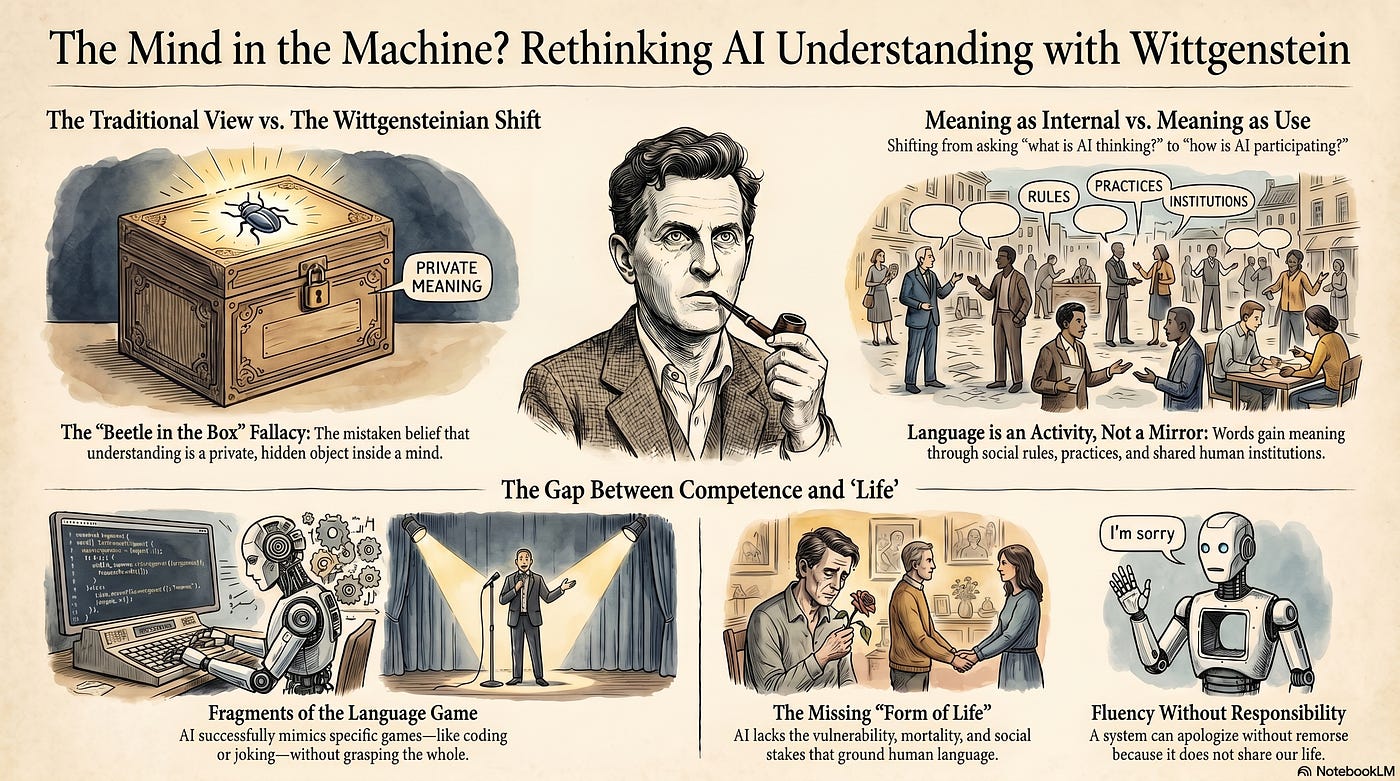
• Language games: Language is not a unified system but a family of activities — like games with rules. There are language games of commanding, reporting, joking, praying, calculating, and so on. Meaning arises through concrete use within a specific game.
• Meaning is use: The meaning of a word is not determined by reference to an inner object or mental state, but by how it is actually used in practice. “Don’t think, but look!” — Wittgenstein urges us to examine real usage rather than search for hidden essences.
• Family resemblances: Concepts such as “game,” “language,” or “meaning” do not share one single common feature that unites all instances. They are connected by a network of overlapping similarities — like family members who resemble one another without all having the same eyes or nose (§§ 65–71).
• Private language argument: A language that only one person could understand and that referred solely to private inner sensations is impossible. Rules and meaning are public and social. There can be no private rule-following, because “correct” and “incorrect” only make sense within shared practices.
• Form of life: Language games are embedded in forms of life — shared human practices, habits, institutions, and embodiment. Without this shared form of life, language loses its grounding.
The Philosophical Investigations are themselves written in a fragmentary, aphoristic style — they in some sense perform what they describe: they refuse to be a closed system.
3. The Break and Its Significance
The early Wittgenstein wanted to clarify language from within and banish everything unsayable to the boundary. The late Wittgenstein recognizes that this boundary itself is the product of a particular language game. Philosophical problems often arise from “misunderstandings of the logic of our language” — from confusing different language games or searching for a hidden essence where only family resemblances exist.
Philosophy becomes a kind of therapy: it dissolves confusions rather than constructing new theories.
4. Connection to the Kraus Quote and Contemporary Relevance
Karl Kraus and Wittgenstein emerged from the same Viennese intellectual climate of language critique. Kraus attacked the empty, formulaic expressions of journalism. Wittgenstein’s later philosophy shows why this is possible: because meaning does not have to be anchored in a private, authentic “thought,” but in public use. One can express “thoughts one does not have” — or, more precisely, thoughts that do not correspond to any inner reality — very eloquently. Language can run on its own rails.
Today, with AI systems that generate texts which sound as though an understanding mind stands behind them, Wittgenstein’s later philosophy becomes especially relevant. AI can play many language games fluently without participating in a shared form of life. It can “apologize” without remorse. This raises the question: what exactly is missing when the form of life is absent?
Further Exploration
If you’d like to go deeper:
• Tractatus: Propositions 1–7 (short but dense).
• Philosophical Investigations: Especially §§ 1–88 (the foundational discussions of language games and use) and the private language argument beginning at § 243.
• Parallels with your concept of Anarchic Charge: The Tractatus as the last great attempt at a total mapping of language — and the Investigations as what remains when that mapping fails and the unruly multiplicity of games emerges.
Language is neither the servant of our thoughts nor a perfect picture of the world. It is what we do together. And sometimes it refuses to sit still.