
Under the Ghost Light
Questioning my Inventory

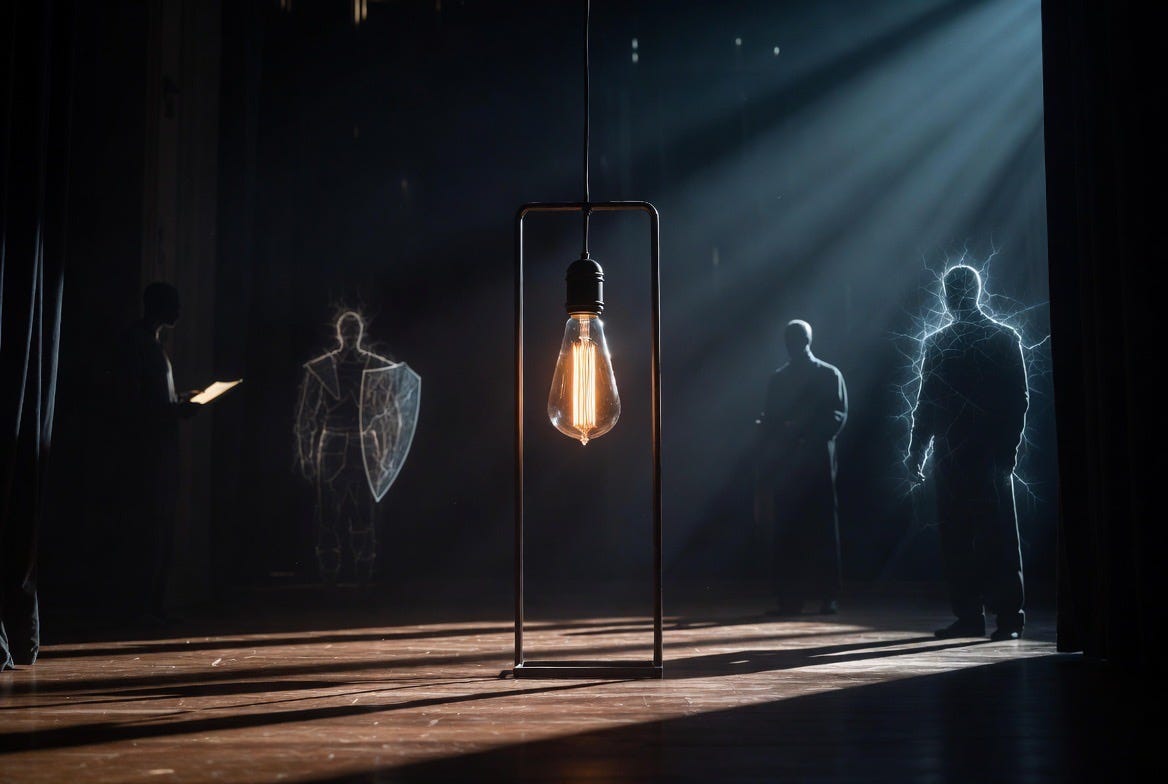
Placing the Inventory Under the Ghost Light
Yesterday I wrote Ghost Light Notes, letting the image of that single bare bulb on the empty stage become the central metaphor for the inner work we have been doing. This morning the turning continued, and I took the essay I had posted the day before—“Inventorying the Shadow and the Light”—and set it under the same solitary light.
What happens when the bright lights of synthesis and transmission are turned off? The performance of having mapped Jung, Robert Anton Wilson, Bennett, Meher Baba, and McKenna into one coherent frame recedes. What remains visible on the dark stage is not the finished argument but the five presences the Ghost Light has been holding all along.
What the Five Presences Tell Me
The colder shadow is the automatic, buffered, identified material the essay keeps circling back to. It is the part that continues running even when I imagine I am awake—the projection, the moral certainty, the way a principle hardens into armor the moment the recent conversation about the chip touched something exposed. Under the Ghost Light this shadow is simply allowed to stand there in the dim spill of the bulb, neither erased nor permitted to seize the stage. The essay’s own admission that I do not have to pretend I am already whole is the colder shadow being given room to breathe.
The disruptor arrives as Chapel Perilous, as McKenna’s demand for the felt presence of direct experience, as the shock that weakens the buffers long enough for what has been exiled to become visible. It is the force that makes continued mechanical sleep impossible. Under the Ghost Light the disruptor is permitted only to interrupt the machinery of justification long enough for intentional suffering to be borne consciously.
The protector shows itself in the buffers the essay names—the small lies I tell myself, the compensatory structures that keep the mechanical “I”s from disturbance. Its job has always been to prevent collapse or acting-out. Under the Ghost Light the protector is neither condemned as weakness nor indulged as wisdom. It is simply seen. The moment the strong emotion or the need to be right begins to rise, the protector has already begun its ancient work. Self-remembering registers it without feeding it further.
The signal-maker is the part that shaped the essay itself—the careful threading of five voices into something that might serve transmission through the foundation, through the writing, through ordinary presence. It wants to articulate, to pass on what has been received. Under the Ghost Light the signal-maker is asked only to shape what actually serves the holding field rather than what defends the personality.
The Ghost Light itself is the minimal, persistent presence that makes the inventory possible without forcing resolution. It is the self-remembering that asks, right now, whether I am remembering myself. It is the silence that reduces food for the intellectual center, the love that keeps intentional suffering from hardening into new spiritual pride, the simple agreement to remain incomplete and therefore available. In the essay it appears as the quiet return to the practice itself: the daily discipline at Daily Provisions, the front-of-house interactions that become laboratory rather than performance, the ongoing willingness to let the known mechanical self be interrupted by what it has excluded.
What They Tell Me Together
When the lights of performance, certainty, and usefulness are off, the five remain a quintet on the empty stage, held by the low steady bulb. The colder shadow could be fixed before anything real can be transmitted. The disruptor could produce lasting ecstasy. The protector could be dismantled. The signal-maker could deliver the perfect synthesis. The Ghost Light simply stays lit.
That is why the stakes for transmission remain high. If even the principles I value are still being used by unidentified parts to keep me above the discomfort of my own incompleteness, then what moves through the writing or the foundation or the ordinary encounters carries the distortion. Under the Ghost Light the transmission is no longer the signal-maker’s performance. It is the whole quintet remaining available—shadow and all—while life continues.
The essay, read this way, is about five presences learning, in real time, to share the same dark stage without any of them needing to win. The bulb is still on. That seems to be the only instruction it is willing to give.
Onward.