
Solutions?
I’ve been thinking…

Here’s the vision again:
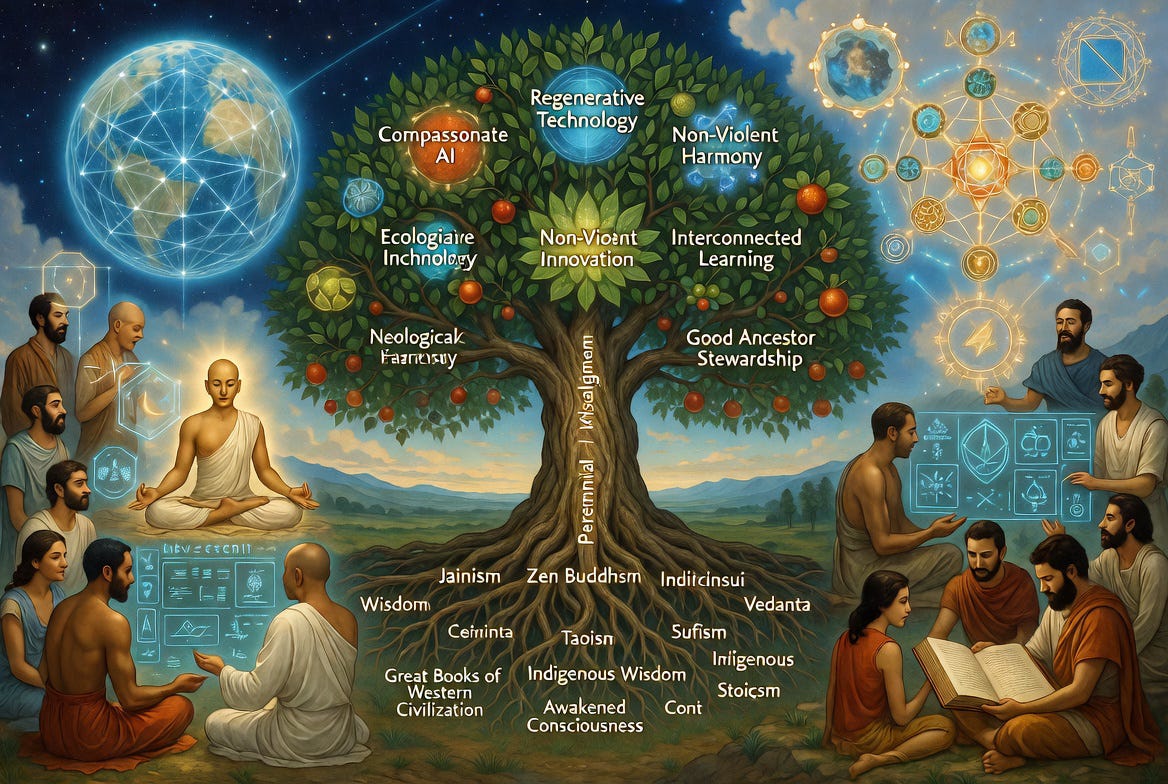
Awakened Techne: A Vision for Wisdom-Guided Learning and Technology
Humanity faces existential threats of its own making—climate destabilization, misaligned artificial intelligence, nuclear weapons, engineered pandemics, ecological collapse, and the deeper crisis of meaning that makes us willing to risk everything for short-term power or comfort. These are technical problems. They are also symptoms of a profound imbalance: our technological power has raced far ahead of our wisdom, our capacity for presence, our sense of interconnection, and our commitment to future generations and all beings.
The remedy is to root ourselves in the deepest accumulated insight of our species—the world’s wisdom traditions—while directing them toward the flourishing of the whole web of life. This is the path of the good ancestor: one who uses every tool of mind and hand to serve awakening rather than illusion, regeneration rather than extraction, and reconciliation rather than domination.
The Perennial Foundations
Every wisdom tradition offers essential medicine for our technological age:
• The Great Books of Western Civilization teach us to examine the human soul, the nature of justice, the limits of power, and the consequences of hubris. Plato’s Republic asks what kind of guardians should steer society—and therefore what kind of education and inner discipline our AI developers and policymakers require. Aristotle offers phronesis—practical wisdom that integrates intellect with ethical perception. The Hebrew prophets and Christian Gospels demand justice for the vulnerable and care for the stranger, including future strangers and non-human life. Shakespeare reveals the tragic consequences of unchecked ambition and self-deception. These texts are not museum pieces; they are mirrors for the technological soul.
• Zen offers the technology of attention itself. Zazen trains direct, non-reactive presence—the only state from which wise action can arise amid complexity and crisis. The principle of interbeing (Thich Nhat Hanh) reveals that no technology is neutral; every algorithm, energy system, and supply chain participates in the web of causes and conditions. Beginner’s mind and non-striving free innovation from attachment to ego or outcome. “Before enlightenment, chop wood, carry water. After enlightenment, chop wood, carry water.” The same applies to coding, governing, and designing energy systems.
• Jainism provides the most rigorous ethical framework for technology: ahimsa (non-violence) extended to all sentient beings in thought, word, and deed; anekantavada (many-sidedness), which insists that truth is multifaceted and no single perspective—scientific, economic, or ideological—can claim finality; and aparigraha (non-possessiveness), the direct antidote to the consumerist and extractive logic driving climate breakdown and resource wars. A technology guided by Jain principles would ask at every stage: Does this minimize harm to the smallest beings? Does it respect multiple valid perspectives? Does it cultivate contentment rather than endless craving?
• All the world’s wisdom traditions converge on perennial truths that technology desperately needs: the fundamental interconnectedness of existence (Indra’s net, Tao, Indigenous reciprocity, Sufi tawhid, Vedantic unity); the primacy of compassion and non-harm; the necessity of humility before mystery; the long view of seven generations or more; the recognition that consciousness itself is not a byproduct but a fundamental dimension of reality; and the call to live as stewards rather than owners of creation.
These are additions to STEM; the operating system for a civilization that can survive its own power.
The Vision in Practice
Learning as Transformation, Not Information Transfer
Education must become an integrated path of intellectual rigor, contemplative practice, ethical formation, and hands-on creation. Imagine academies and universities where students read Plato and the Heart Sutra in the same week, practice zazen before design studios, study anekantavada while modeling climate systems, and engage in ecological restoration as part of their “lab work.” Great Books seminars become living conversations across traditions. Technology labs become places of ethical and phenomenological inquiry: What does this tool do to human attention? To our relationship with the living world? To future generations?
Technology as Awakened Craft (Techne Sophia)
Technology development ought to be preceded by “wisdom impact assessments” drawing on diverse practitioners; elders, contemplatives, philosophers, scientists, and affected communities. AI alignment would expand beyond preventing harm to actively cultivating wisdom: training systems on curated corpora of the world’s wisdom traditions alongside scientific data; designing interfaces that reward presence, perspective-taking, and long-term thinking rather than addiction and outrage; building AI that can simulate multi-generational consequences and surface hidden assumptions (the technological equivalent of a koan or Socratic dialogue).
Regenerative technologies including energy, materials, food systems, biotechnology would be designed with reverence for life’s complexity, drawing on Taoist wu wei (working with natural flows), Jain non-violence, Indigenous reciprocity, and Western ingenuity. The goal shifts from domination or optimization to participation in the self-organizing intelligence of the biosphere.
Governance and Culture
Decision-making bodies addressing existential risks would include not only technical experts but wisdom councils—people deeply formed in contemplative traditions and ethical philosophy. Success metrics would evolve beyond GDP to include measures of biodiversity, social trust, mental and spiritual well-being, and the felt sense of living in a meaningful, interconnected cosmos. Cultural narratives would celebrate the good ancestor, the bodhisattva engineer, the zen technologist, and the ahimsa innovator as the highest callings.
Personal and Collective Practice
No systemic change endures without inner transformation. Daily disciplines of study (Great Books and living wisdom texts), meditation or prayer (Zen, centering prayer, zikr, etc.), ethical vows or examen (Jain mahavratas, Stoic reflection, Ignatian examen), and mindful technology use become as normal as brushing teeth. Communities form “wisdom hubs”—blending libraries, meditation halls, maker spaces, and mutual aid—that serve as living laboratories for the integration we need.
Meeting the Threats
• Climate and ecological collapse: Technology accelerates the transition to regenerative systems while cultural and inner work dismantles the greed and dissociation that make extraction seem normal. Aparigraha and interdependence become economic and design principles.
• AI misalignment: We constrain AI as we educate it—and ourselves—in the perennial insights that make wisdom possible. Alignment becomes a shared civilizational practice of awakening rather than a narrow technical fix.
• Nuclear and catastrophic conflict: Non-violence traditions (Jain, Buddhist, Gandhian, Christian, Indigenous) inform both technology (verification, de-escalation tools) and the deeper cultural shift from enemy-making to recognition of shared humanity and shared vulnerability.
• Pandemics and bio-risks: Global cooperation is grounded in compassion for all beings and rigorous honesty about uncertainty (anekantavada), not just surveillance and control.
• The meaning crisis: Perhaps the deepest threat. When learning and technology reconnect us to the living mystery, to our ancestors and descendants, and to the call to serve something larger than the small self, despair and nihilism lose their grip.
The Path Forward
This vision may seem utopian. It is a disciplined, practical response to the scale of the dangers we face. It begins wherever we are: in how we design a single algorithm, teach a single class, structure a single organization, or conduct a single conversation. It scales through networks of practice, pilot institutions, policy experiments, and cultural storytelling.
The choice before us is stark. We can continue developing ever more powerful tools while remaining spiritually and ethically adolescent—risking everything on the gamble that power without wisdom will somehow save us. Or we can consciously mature: letting the Great Conversation of humanity’s wisest voices, the direct insight of contemplative traditions, and the ethical rigor of paths like Jainism guide our learning and our technology toward the only outcome worth having—a flourishing, awakened planetary civilization in which all beings can realize their nature.
This is not a rejection of progress. It is progress understood at the level of consciousness itself.
We are not merely problem-solvers. We are participants in a vast unfolding. When our tools are shaped by presence, compassion, many-sided truth, and reverence for the whole, technology becomes what it was always meant to be: an extension of awakened human (and post-human) creativity in service of life.
May we become worthy ancestors.
May our learning and technology serve the awakening of all beings.
May we choose, in this critical window, the path of wisdom.