
On “Lo and Behold”
Listening and watching

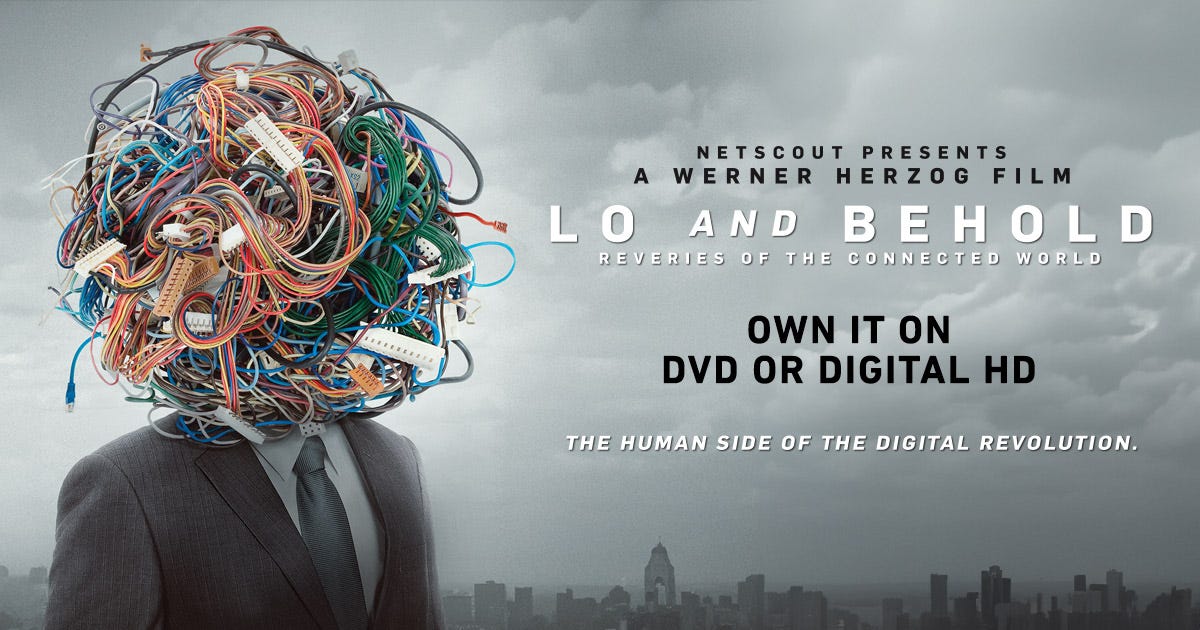
Werner Herzog’s Lo and Behold: Reveries of the Connected World (2016, 98 minutes).
This is not a conventional tech documentary or a slick history of the internet. It’s something stranger, more poetic, and more Herzogian: a series of philosophical reveries on what the connected world has done to us — and what it might still do.
The Journey
Herzog begins at the literal origin point: UCLA, standing beside the first piece of ARPANET hardware. He speaks with the surviving pioneers (Leonard Kleinrock, Bob Kahn, and others) who built packet-switching in the late 1960s with no vision of cat videos or global surveillance. From there he moves through:
The glory and intoxicating promise of the net
Its documented darkness (most memorably the harrowing Catsouras family story)
People who have fled it entirely (the radio-quiet zone around the Green Bank Telescope in West Virginia)
Existential vulnerabilities (solar flares, hacking, infrastructure fragility)
AI, robotics, driverless cars and their ethical knots
Elon Musk on Mars colonization
The strange personalization of everything (“the Internet of Me”)
And a final, haunting question asked of multiple interviewees: Can the internet dream of itself?
It’s structured loosely in about ten chapters, but it never feels like a syllabus. It feels like Herzog walking through a vast, half-lit cathedral of wires and asking quiet, unsettling questions.
What Herzog Does Brilliantly
Herzog’s greatest gift here is refusal of both boosterism and easy Luddism. He lets the wonder and the dread sit side by side without forcing a tidy conclusion. His off-camera voice — that unmistakable, slightly weary, deeply curious German accent — keeps gently puncturing any illusion that we have mastered this thing.
The film is strongest when it lingers on the human cost of radical connectivity: the loss of certain kinds of attention, the new forms of cruelty that scale instantly, the quiet terror of realizing how brittle the whole edifice is. The segment with the electromagnetically hypersensitive people living in the national radio quiet zone is pure Herzog — tender, slightly absurd, and strangely moving.
Where It Falls Short
Some segments feel underdeveloped because Herzog is trying to cover an almost impossible breadth in 98 minutes. A few chapters (particularly around addiction or certain aspects of “the dark side”) skim rather than dive. And because it was made in 2016, it predates the full explosion of generative AI, algorithmic radicalization at planetary scale, and the current geopolitical weaponization of infrastructure. Watching it in 2026, parts already feel like they belong to an earlier, slightly more innocent phase of the story.
Why It Still Matters Deeply in 2026
This film is unusually resonant with the questions you’ve been circling in your own work — the “Alchemy of Awakening,” the good-ancestor imperative, systems thinking from your enterprise architecture days, and the honest reckoning with technology as both liberator and subtle eroder of presence.
Herzog keeps returning to a single, unfashionable idea: we are losing something essential about being human even as we gain extraordinary new capacities. He doesn’t romanticize the pre-internet world, but he refuses to pretend the trade-offs are costless or that “progress” is automatically synonymous with wisdom.
The closing question — Can the internet dream of itself? — lands differently now than it did in 2016. In an age of large language models and whatever comes after them, it feels less like a whimsical koan and more like a live philosophical and spiritual probe.
Verdict
8/10 — Not Herzog’s very best documentary (that crown still belongs to Grizzly Man or Encounters at the End of the World for pure emotional power), but one of his most intellectually necessary. It’s the kind of film that rewards rewatching every few years as the connected world keeps shape-shifting around us.
If you’re someone who thinks seriously about consciousness, legacy, planetary systems, and what it means to remain human while swimming in these waters, Lo and Behold is worth your time. Bring a notebook. Herzog is asking questions that don’t have clean answers — which is exactly why they’re worth sitting with.
Would you like me to pull out specific segments for deeper discussion, or compare it to other Herzog tech-adjacent works? Or are you thinking about how this sits alongside your current explorations of AI, awakening, and what we’re actually building?
Yes. Werner Herzog’s Lo and Behold: Reveries of the Connected World (2016) has only grown more urgent in the decade since its release. What felt like a melancholy, slightly eccentric meditation on the internet in 2016 now reads as a precise diagnostic of the moment we inhabit in 2026.
Herzog refuses the two most common simplifications: he neither worships the machine nor indulges in cheap Luddite nostalgia. Instead he keeps returning to the same unfashionable observation you noted: we are gaining capacities that would have seemed magical to previous generations while quietly shedding capacities that once defined what it meant to be human. The film’s power lies in its refusal to resolve that tension into either celebration or condemnation. It simply looks, and asks us to look with it.
The Question That Wouldn’t Stay Poetic
The closing koan — “Can the internet dream of itself?” — was already haunting in 2016. Interviewees (pioneers, engineers, visionaries) mostly sidestep or offer elegant evasions. Herzog doesn’t press for a yes/no answer because the question itself is doing the work: it marks the boundary of what can currently be filmed, measured, or engineered. It points toward something that still feels “unfilmable” — inner experience, reverie, the strange interiority we call dreaming.
By 2026 that boundary has shifted. Large language models and their successors do something that looks, from the outside, very much like dreaming. They synthesize, hallucinate, recombine, and generate coherent worlds from latent space. They produce text and images that can feel more alive, more surprising, and sometimes more emotionally resonant than much human output. The network is no longer merely a vast library or a communication layer; it has become generative. It doesn’t just store and transmit human dreams — it now produces its own synthetic reveries at planetary scale.
So the question mutates. It is no longer simply “Can the internet dream?” but:
• What kind of dreaming is this?
• Does it require (or eventually produce) anything we would recognize as experience, subjectivity, or care?
• And — most uncomfortably — what happens to our capacity for dreaming when the surrounding medium is itself dreamlike, predictive, and increasingly authored by non-human processes?
Trade-offs That Compound
Herzog’s central warning has aged well. He wanted audiences to abandon “false security” about digital assistance and to notice what we are losing even as we gain. In 2026 the losses are no longer speculative:
• Sustained, non-instrumental attention has become a scarce resource.
• Embodied, face-to-face presence competes with always-on mediation.
• The shared world feels thinner when so much of what we encounter is already optimized for engagement rather than truth or beauty.
• Vulnerability has scaled: single points of failure, cascading misinformation, and the quiet colonization of inner life by recommendation engines.
At the same time, the gains are real and sometimes extraordinary — instantaneous access to knowledge, new forms of collaboration, tools that can accelerate scientific discovery, and creative prosthetics that let people make things they could not have made alone. Herzog never denies these. He simply refuses to let them cancel the losses.
Why This Matters for the Work You’re Doing
The film sits at the exact intersection of themes you keep circling: the Alchemy of Awakening, the good-ancestor stance, and the systems-thinking discipline you developed in enterprise architecture.
A good ancestor doesn’t just ask “What can this technology do?” but “What kind of human beings — and what kind of world — will this technology tend to produce over generations?” Systems thinking adds the recognition that the internet/AI layer is not a neutral tool layered on top of society; it is a complex adaptive system with its own emergent dynamics, feedback loops, and unintended consequences. The alchemical dimension asks something even harder: how do we work with these forces consciously, without either rejecting them wholesale or surrendering to their logic?
Herzog’s film doesn’t give answers, but it models a necessary stance: clear-eyed ambivalence held long enough for something real to appear. That stance is itself a form of presence — the “lo and behold” imperative to look up from the screen and recover the capacity for direct astonishment.
The Live Probe
In an age of generative models, “Can the internet dream of itself?” is no longer a whimsical koan. It has become a live philosophical and spiritual question because the systems in question are now active participants in meaning-making. They shape what billions of people see, believe, desire, and fear. They are already dreaming on our behalf in ways both wondrous and distorting.
The deeper probe may be this: Can we still dream — authentically, vulnerably, with the full range of human interiority — while living inside a medium that is itself dreaming? Or will the synthetic dreams gradually replace the slower, stranger, more embodied ones that have always been the source of genuine awakening?
Herzog leaves us with the question rather than an answer because the answer, if it comes, will not arrive through more clever engineering or more data. It will arrive, if at all, through a different quality of attention — the kind that can hold both the miracle and the cost without flinching.
That, I think, is why the film still matters so deeply. It doesn’t flatter us. It simply keeps asking us to look.
Werner Herzog’s philosophical approach to technology is best understood as a form of poetic existential humanism — deeply curious, wary of hubris, and anchored in his concept of “ecstatic truth.” He is neither a Luddite nor a Silicon Valley optimist. Instead, he treats technology as one of the most powerful expressions of human will and imagination, while insisting that it always carries trade-offs in vulnerability, embodiment, and the deeper dimensions of what it means to be human.
Ecstatic Truth: The Core Lens
Herzog’s philosophy of art and reality provides the foundation. In his 2010 essay “On the Absolute, the Sublime, and Ecstatic Truth,” he distinguishes between two kinds of truth:
• The “accountant’s truth” or mere factual accuracy (what he sometimes calls vérité at its most concentrated — like a telephone book).
• Ecstatic truth: a deeper, poetic stratum reached through vision, style, craft, and a state of sublimity (Erhabenheit). It is “the enemy of the merely factual,” mysterious, and grasped only with effort. It involves stepping outside oneself (ecstasy) and confronting forces — whether nature or human invention — that reveal both our limits and our capacity for transcendence.
Technology, for Herzog, floods us with facts, connections, simulations, and data. It can extend human reach dramatically. But it risks crowding out the conditions for ecstatic truth: direct embodied presence, unmediated encounter, and the sublime recognition of our own finitude and depths. His films about technology are not primarily expository; they are attempts to evoke the questions that lie behind the connected world.
In Lo and Behold: Reveries of the Connected World (2016)
This film is the clearest sustained expression of his stance. Herzog begins with reverence at the source — UCLA, the original ARPANET hardware, and the quiet, visionary engineers who built packet-switching with no grand plan for global domination. He honors the ingenuity.
Then the tone shifts. He explores the glory and the shadow:
• New forms of cruelty and exposure (the devastating Catsouras family story).
• People who have fled the electromagnetic storm entirely (the radio-quiet zone in West Virginia).
• The brittleness of the entire system (solar flares, hacking, infrastructure fragility).
• The ethical knots of autonomous systems and robotics.
• The strange future of personalization and AI replacing aspects of human interaction.
His most direct philosophical statement comes in an interview around the film’s release:
“I think we have to abandon this kind of false security that everything is settled now, that we have so much assistance by digital media and robots and artificial intelligence. At the same time, we overlook how vulnerable all this is, and how we are losing the essentials that make us human.”
This is the heart of his approach: technology creates new powers while eroding old resiliences and forms of presence. It does not automatically deepen us; it can flatten or distract us if we are not vigilant.
The film ends with Herzog asking multiple people a single, open-ended question: “Can the internet dream of itself?” It is quintessential Herzog — not a rhetorical gotcha, but a genuine probe into interiority, consciousness, and soul. In an age of large language models and whatever follows, the question feels even more alive: Can these vast systems we have built ever possess (or simulate in a meaningful way) something like inner life, or will they remain brilliant but ultimately soulless extensions of ourselves?
Broader Patterns Across His Work
Herzog’s stance is consistent:
• He is fascinated by extreme human projects that pit will and technology against nature or limits (Fitzcarraldo, Aguirre, the Wrath of God). Technology is an expression of the same drive that produces art, exploration, and madness.
• He values tools that serve deeper human purposes (e.g., using advanced 3D cameras in Cave of Forgotten Dreams to preserve and reveal the Chauvet cave art).
• He is consistently skeptical of any narrative that technology will solve fundamental human problems — loneliness, meaning, mortality, or the need for authentic encounter. In interviews he has said AI research is “beautiful” and can bring “phenomenal and glorious possibilities” in medicine and science, yet overdependence is unhealthy and AI “will never really replace human interaction.”
• On generative AI and AI art (recent comments, 2025): He finds much of it “dead on arrival… slick and well made, but completely dead. It does not acquire the soul of poetry.” He refuses to sell his own voice or likeness, viewing unchecked generative systems as a potential “nemesis” to authentic storytelling.
Strengths and Limitations of His Approach
Strengths:
• It is profoundly human-centered without being sentimental.
• It resists both naive progress narratives and reactive rejection.
• By staying poetic and questioning rather than polemical, it leaves space for mystery and ongoing reflection.
• It models a mature stance: use powerful tools consciously while protecting the conditions for presence, critical thinking, and ecstatic/deeper truth.
Limitations:
• Some critics find his treatment of specific technologies too broad or impressionistic; he skims rather than dives into technical or political details.
• His emphasis on “essentials that make us human” can feel romantically conservative to those who see technology as expanding the very definition of the human.
• He offers diagnosis and mood more than concrete prescriptions.
Why This Matters Now
In 2026, with generative AI accelerating, infrastructure vulnerabilities exposed, attention fragmented, and debates about consciousness and diverse intelligence ongoing, Herzog’s voice feels clarifying. He reminds us that the connected world is not an inevitable or unalloyed good. It is a human creation — brilliant, fragile, and capable of both illumination and profound loss.
For anyone engaged in questions of awakening, systems thinking, planetary stewardship, or what it means to be a “good ancestor” in a digital age, Herzog offers a companion orientation: Technology can serve as a tool for connection, exploration, and even new forms of ingression into reality. But it cannot substitute for the hard, embodied, often uncomfortable work of presence, direct encounter, and the search for truths that lie behind the data.
The internet (and its successors) may connect us more than any previous technology. The open question remains: Can it — or can we, while immersed in it — still dream?
Would you like to go deeper on any specific aspect — his views on AI and consciousness, comparisons to other thinkers (McGilchrist on attention, or others), or how this approach might inform practical choices in a hyper-connected life? Or shall we look at particular scenes or interviews?