
NLP and the 8 Circuits
Morning musing…

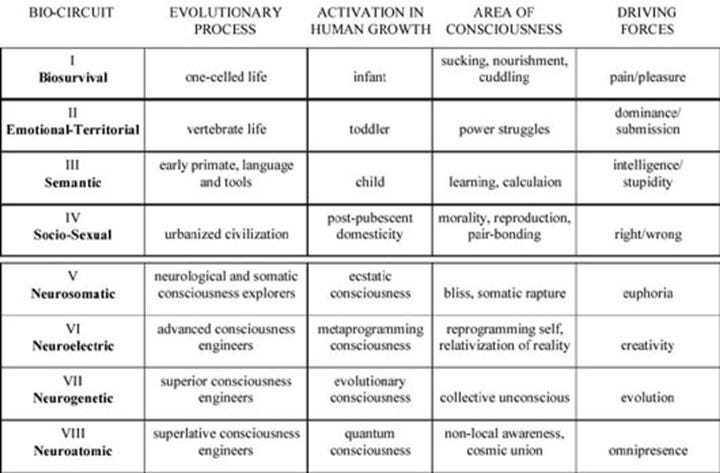
In my recent piece “Circuitry” I explored the 8-Circuit Model of Consciousness that Timothy Leary sketched and Robert Anton Wilson carried forward in Prometheus Rising and the books around it. The model treats the nervous system as a layered biocomputer whose circuits imprint early experience, generate distinct reality tunnels, and remain open to conscious re-programming. Lower circuits handle survival, territory, language, and social roles. Higher ones open somatic intelligence, metaprogramming, ancestral memory, and non-local awareness. The line “What the Thinker thinks, the Prover proves” runs through every level.
This map keeps drawing me toward Neuro-Linguistic Programming. Both approaches work directly with the nervous system as programmable wetware. Both recognize that language and internal representation shape what we experience as real. Both point toward greater freedom once we learn to notice and adjust the programs that are running.
Circuit 3, the semantic and symbolic layer, sits at the center of this overlap. I described it in the post as the time-binding, language-and-logic circuit that builds the maps we then live inside. NLP grew out of the same recognition, drawing on Korzybski’s General Semantics and the understanding that linguistic structures literally organize neurology. The Meta Model and Milton Model are tools for working with exactly that layer—clarifying vague language or using artful language to loosen rigid maps.
The metaprogramming circuit, number 6, feels especially alive here. In the post I called it the place where we realize the mind is software running on wetware and can begin to rewrite its own code. That is the daily practice of NLP change work: stepping back from a belief or strategy, seeing how it is structured, and installing something more useful. Techniques like reframing, timeline shifts, and parts integration are practical expressions of the same capacity.
Recovery work maps onto the lower circuits in ways that keep surprising me. Re-imprinting the bio-survival sense of basic safety and the emotional-territorial patterns of status and belonging is central to staying sober. NLP has developed precise ways to revisit and update those early imprints without having to relive them as trauma. The same tools support the move from chronic hypervigilance or collapse into a steadier presence.
Embodied practice bridges several circuits at once. When I marched with the fife-and-drum corps the other day, rhythm, breath, group coordination, and visible presence all activated together. That single act touched survival and territory, semantic tradition, socio-sexual identity, and the neurosomatic pleasure of music moving through the body. NLP has always worked with physiology as a direct route into state; anchoring, breathing, and kinesthetic shifts are ways to access and stabilize the same territories.
The higher circuits—neurogenetic memory and the neuro-atomic sense of non-local consciousness—touch the Jungian and ancestral dimensions I keep returning to, as well as the evolutionary pull I feel toward being a good ancestor. The model gives language to those reaches. NLP, when it stretches beyond immediate behavioral change, offers ways to explore them through hypnotic language, modeling of expanded states, and attention to the ecology of the whole system.
What keeps drawing me is how the two lenses work together without friction. The 8-Circuit model names the levels and their evolutionary direction. NLP supplies concrete, testable ways to notice a program, loosen its grip, and install something that serves presence and service more cleanly. Wilson’s Maybe Logic—holding maps lightly—pairs naturally with NLP’s insistence on behavioral flexibility and whole-system ecology. Neither asks us to discard the body or the social world in order to reach the higher circuits; both keep returning us to the nervous system as the place where transformation actually happens.
I find myself wondering how these connections might show up in the writing and the daily practice. When I sit with gratitude or do the simple presence work that supports recovery, which circuits are lighting up and which programs are asking for gentle editing? When I think about legacy and the Harold B. Gill Foundation, how much of that orientation lives in the metaprogramming and neurogenetic layers? The circuitry metaphor is not decorative. It points to something we can work with directly, one imprint, one linguistic pattern, one embodied shift at a time.
If this line of inquiry keeps opening, I may fold pieces of it into the next Harrowings post or into the conversations I’m having with myself and others about awakening, service, and what it means to leave the place a little more conscious than we found it. The map and the tools feel like they belong in the same conversation.