
Musing on Substack and Its Contents
With Apologies to Freud.

Civilization and Its Discontents by Sigmund Freud is my springboard for this article.
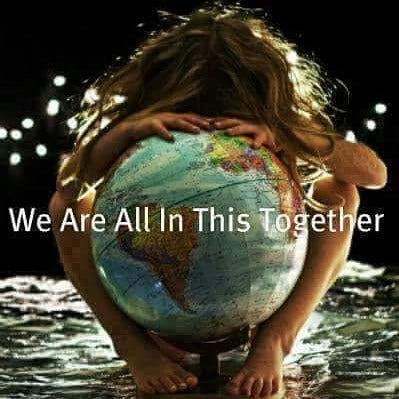
The image here of a child holding the globe and reminding us that we are all in this together is key to understanding what I’m about to be saying.
Here on Substack, it seems that many are treating this no differently than any other social media platform; instinctively “liking” posts but not leveraging the tools that we have available. Admittedly, Substack can take a bit of learning. It is also under constant development. It allows us not only to “like” a note or an article but also to amplify it in manifold ways. The easiest, of course, is to Restack. Restacking with a Note goes a step further. Then Substack offers the ability to push the link out to Facebook, Twitter (now X), and LinkedIn or BlueSky very easily where the signal might be picked up by still others not yet on Substack. I do a lot of this. Why don’t others?
My sense is that many here (if not most) are quite content to treat Substack as just another social media platform. It is, however, vastly more than that. It easily allows us to podcast out to YouTube, Spotify, Apple Podcasts, and ACast as well as generating the RSS link for further amplification. It is the media now. It can be vastly more.
So far, its founders have remained true to their initial impulse not to make this an advertisement vehicle and I hope they never do. It’s pure in that aspect. It does allow us to monetize our content relatively easily and I hope many will. It is the preferred platform for a number of voices that I have found important to my own development. Among these are Patti Smith and her daughter, Jesse Paris Smith. Ted Gioia provides thought-provoking posts regularly. I’m especially fond of my fellow Theosophist, 𝐌𝐢𝐭𝐜𝐡 𝐇𝐨𝐫𝐨𝐰𝐢𝐭𝐳, who is prolific. There are so many to whom I could point.
I’ve also been very fortunate to run into other folks who are contributing more quietly to our culture including Lee Penman, The Intrepid Editor Press, Everyday Junglist, Giulia Cassarà, PhD, and the list goes on. I hope that folks will have a look at these writers and help them be heard, if not go viral.
Of course, going viral is not the point here. The work I am doing is largely targeting the research historian of the future who might have an interest in how we got where we are going. It’s a perspective from one corner of the planet. I’m convinced that we are on the threshold of great things for life on the planet generally, if we live up to the sapiens part of our species Latin name. At present though, I believe we are more homo economicus than sapiens. We are often unconsciously spending that energy we call money which has effects far beyond the immediate acquisition of stuff. It’s time we woke up to the fact that every cent spent is a vote for the kind of world we are co-creating.
It’s always my hope that someone out there will pick up what I’m putting down. If they do and something beneficial happens as a result, that’s gravy. If not, I’ve taken my shot. After all, one misses 100% of the shots that one does not take.
Onward!
Click a button. Any button…
I slightly disagree – as somebody who is bedbound, I treat this place as a scrapbook. I read everything I like – but I don’t want to be thinking of sharing it all the time, and having to use other platforms to share on. I use it to escape from a physical world that is difficult and the photos and poetry I share help me to daydream. I think there are different ways to use it, and yours is admirable.
It's interesting for me that you consider yourself a Theosophist, Hal. Many people have never even heard of that spiritual path. I belonged to a group of young Theosophists throughout my formative years (a blessing while growing up in a state-church dominated Lutheran Sweden, where religious freedom was an unknown idea.) Theosophy offered a wide-enough framework for understanding Life and Reality to save me from "suffocating" spiritually. I left the state-church at age 15, when I had started to practice yoga, which I did for many years. After that came a long and winding spiritual path – TM, Tibetan Buddhism, channeling, ACIM and more. ---
I guess I'm one of those who treats Substack as a social media. Well, I don't frequent or use any other social media. I am a tech chimp, not by choice really, but by necessitude. Posting here my poetry and my essays twice a week, without any extra like photos, AI-generated pictures or videos, is just about what I am able to. I am 88 and most people my age stay away from computers completely. ---
Being married to a computer- and technical specialist for 41 years allowed me to stay away from things technical. My hubby died 3 years ago, I was his caregiver for 8 years. When he got dementia I had to totally rethink my stance. As my hubby often messed up computer things royally over the years I had to learn a staggering number of new things and slowly take over. ---
I wrote my first email ever about 6 years ago. The learning curve was steep, hard and scary. I have dealt with complex trauma for my whole life (apart from the last 2 years), so every mistake I did while learning sent a shock reaction through my being (emotional flashbacks). It was exhausting and added to the exhaustion that usually follows a primary caregiver. ---
And it was not only learning how to use the computer itself properly that was new, there were printer, scanner, backup disks to learn about. There was also learning how to navigate the internet, how to do things online (and in my second language). It was like learning a new language (and I am already bi-lingual) ---
But when you are in your 80s, even if your mind is sharp, the capacity you have to take in new things and remember them is NOT the same as it was in your younger days. I am still learning new things daily, although I resist some new things which I could do for example on Substack. I recently learned how to DM, at least how to answer. ---
Next thing could be how to Restack. I guess I just press that Restack button, but I have no idea what happens then (I could ask Substack support, but I'm too darn tech-tired to understand their explanations). What's the point of restacking? How does it improve the reach of an article? ---
You have often invited your readers to respond, react and comment. I hope that this harangue was not more than you bargained for :). With love, Maria