Communication Norms
Studying the way our species does it…

Cultural communication norms shape how people encode and decode messages, build trust, handle disagreement, and express (or withhold) emotions. These norms are not fixed rules but patterns that emerge from history, values, social structures, and environments. They exist on continua rather than strict binaries, and individuals within any culture vary widely based on personality, education, migration, and context.
Two foundational frameworks help explore them: Edward T. Hall’s high-context versus low-context communication and Geert Hofstede’s cultural dimensions, especially individualism-collectivism and power distance. These interact with nonverbal cues, concepts of face and harmony, and time orientation.
High-Context versus Low-Context Communication (Edward T. Hall)
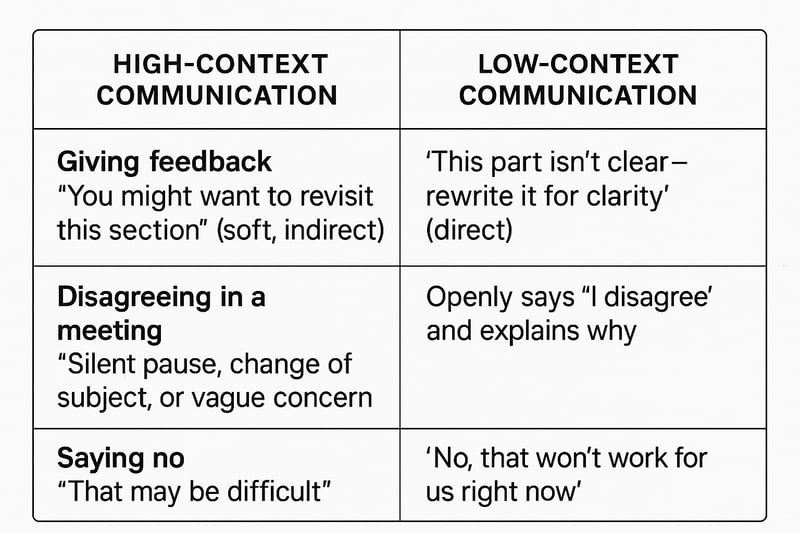
Hall’s model distinguishes cultures by how much meaning resides in the explicit words versus the surrounding context, relationships, and nonverbal signals.
High-context cultures, found in much of East Asia, Arab and Middle Eastern cultures, many African and Latin American societies, and Southern Europe, rely heavily on implicit communication. Speakers draw on shared history, relationships, nonverbal cues, tone, silence, and situational context. Directness can feel rude or disruptive to group harmony and face-saving. Vague or indirect phrasing is often a polite and normative way to preserve relationships and allow flexibility.
Low-context cultures, such as the United States, Germany, Scandinavia, the Netherlands, much of Northern Europe, and Australia, carry most meaning in the explicit verbal message. Clarity, directness, and precision are highly valued. People tend to spell things out to reduce ambiguity, even when speaking with strangers. Indirectness in these settings can be interpreted as evasive or unclear.
These differences connect directly to our earlier discussion of vague requests and non-assertive styles. In high-context cultures, indirect or vague phrasing is frequently a respectful norm for maintaining harmony or gently testing relational waters. It is not necessarily experienced as non-assertive or evasive. In low-context cultures, the same approach can read as unclear or passive.
The styles are not inherently better or worse. High-context communication excels at building deep trust and nuanced understanding within established relationships. Low-context communication supports speed, clarity, and scalability when interacting with diverse or unfamiliar people.
Broader Cultural Dimensions (Hofstede and Extensions)
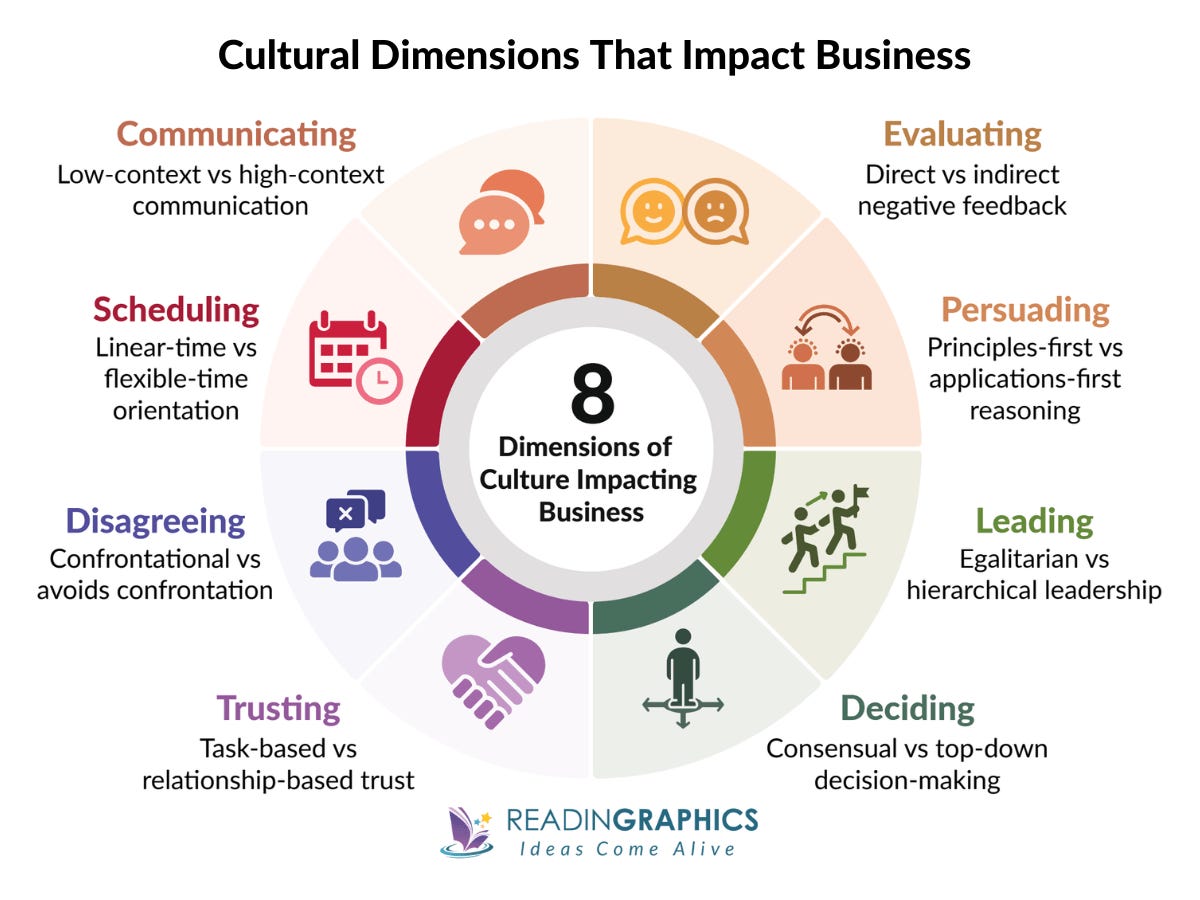
Hofstede’s research, along with later frameworks such as Erin Meyer’s Culture Map, highlights several interacting dimensions that shape communication.
Individualism versus collectivism influences whether self-expression and personal opinions are prioritized or whether group harmony and loyalty take precedence. Individualistic cultures, common in the United States, United Kingdom, Australia, and the Netherlands, tend to favor direct advocacy of personal views. Collectivistic cultures, widespread across much of Asia, Latin America, and Africa, often emphasize saving face for the group and avoiding open confrontation that could disrupt collective bonds.
Power distance affects formality and deference. High power-distance cultures, found in many hierarchical Asian, Latin American, and Middle Eastern settings, commonly use more formal language and indirect communication when addressing authority. Low power-distance cultures, such as those in Nordic countries and often in professional U.S. contexts, encourage more egalitarian directness and open challenge.
Additional relevant dimensions include uncertainty avoidance, which reflects comfort with ambiguity, and emotional expressiveness, which ranges from more affective and animated styles to more neutral and restrained ones. Time orientation also plays a role, with monochronic or linear approaches favoring sequential focus and polychronic or flexible approaches allowing multiple threads and relational priorities to coexist.
These dimensions help explain why the same behavior, such as silence, indirectness, or emotional restraint, can signal respect and thoughtfulness in one cultural frame and disengagement or weakness in another.
Nonverbal and Paralinguistic Norms
Nonverbal elements often create the most cross-cultural friction because they operate below conscious awareness.
Eye contact norms vary widely. Sustained direct eye contact is frequently interpreted as a sign of confidence and honesty in many low-context Western settings. In numerous East Asian, some African, and Indigenous contexts, prolonged eye contact, especially with elders or superiors, can be read as disrespectful or confrontational.
Silence and pauses carry different weight. In many high-context Asian and Native American or Indigenous traditions, thoughtful silence signals respect or careful consideration. In low-context environments, extended silence can feel awkward or be mistaken for disagreement or disengagement.
Personal space and touch also differ. Closer proximity and more frequent touch are normative in many Latin American, Arab, and Southern European cultures, while larger personal bubbles are preferred in Northern European, U.S., and East Asian settings.
Gestures and posture send powerful signals that shift dramatically across regions. A thumbs-up, index-finger pointing, or showing the soles of the feet can be positive in some places and deeply offensive in others. Posture such as slouching or placing hands in pockets may convey disrespect in certain cultural contexts.
Volume, speed, and emotional display follow their own patterns. More animated and louder speech is common and accepted in some Mediterranean, Latin American, and African American communicative styles, while greater restraint is valued in many East Asian contexts.
Why This Matters and How to Navigate
In our interconnected world, mismatched cultural norms frequently generate misunderstanding. What registers as vague or non-assertive in one cultural lens may represent sophisticated relational skill in another. Direct bluntness, meanwhile, can unintentionally damage trust or face.
Effective navigation begins with observation and adaptation. Pay attention to patterns in context, relationships Status, and nonverbal cues before drawing conclusions about intent. Use respectful clarifying questions such as “I want to make sure I understand correctly—are you suggesting…?” or “How would you prefer we handle feedback in this situation?”
Building relational context helps, especially when working across high-context preferences. Cultural humility is essential: assume positive intent, recognize the limits of your own cultural lens, and remain curious rather than judgmental. In mixed settings, hybrid approaches often succeed—being clear on essential points while remaining attentive to relational harmony and face.
These norms continue to evolve under the pressures of globalization, migration, digital communication, and generational change. Many environments today are increasingly hybrid.
Understanding cultural communication norms ultimately supports greater clarity, reduced projection, and more skillful presence across difference. It deepens our capacity to connect authentically in a plural society.