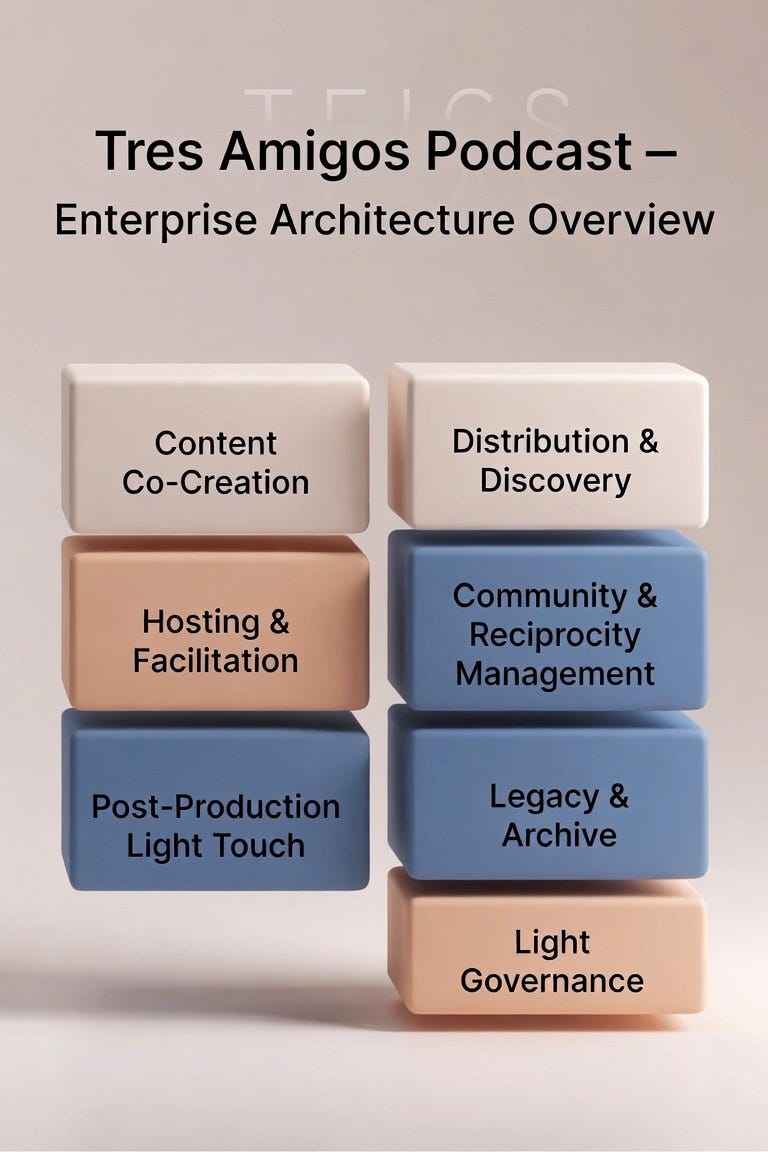
Applying Enterprise Architecture to Tres Amigos Podcast
Bringing The Open Group Architecture Framework to bear…

TOGAF-compliant Enterprise Architecture for the Tres Amigos / Collaborative Harrowings Podcast (Hal Gill / Harrowings, Everyday Junglist / Intelligent Nonsense, Bruno Bettati).
This treats the emerging collaborative podcast (“Tres Amigos” and related Harrowings / Intelligent Nonsense live conversations and episodes) as the target “enterprise.” It draws from the recent live sessions (including the August 2026 Tres Amigos reciprocity discussion and prior Intelligent Nonsense episodes featuring the three of you), the recurring Harrowings live video format, themes of awakening/self-excavation/shadow work/legacy, and the informal but high-signal conversational style that has developed.
The architecture follows the TOGAF Architecture Development Method (ADM) at a practical scale suitable for a small, creative, multi-host media/legacy project rather than a large bureaucracy. It is deliberately lightweight, principle-driven, and oriented toward sustainability, authenticity, and “good ancestor” outcomes rather than pure growth metrics.
Preliminary Phase
Scope: The collaborative podcast operation and its supporting ecosystem (content creation, distribution, community, archiving, and light monetization via Substack paid subscriptions / Harold B. Gill Foundation Board status).
Architecture Principles (adapted from TOGAF and your prior federal EA work):
• Authenticity and presence first (no forced formats that kill the “excavation” quality).
• Reciprocity and clear contribution boundaries among the three hosts.
• Reuse and simplicity (leverage existing Substack Live, Spotify, YouTube, and personal tools).
• Legacy and archivability (episodes as primary documents for the Foundation and personal “Passing Show”).
• Consciousness-friendly technology (tools that support rather than distract from shadow work, awakening, Jungian inquiry, science/humor, film/production insight, and daily practice).
• Minimal viable bureaucracy.
Stakeholders: The three hosts; Harrowings / Intelligent Nonsense / Bruno’s Substack audiences; paid “Board” subscribers; Foundation; occasional live listeners/commenters.
Phase A: Architecture Vision
Vision Statement: A sustainable, low-friction collaborative podcast (“Tres Amigos” and related cross-posts) that serves as a living laboratory for mutual excavation—shadow work, awakening, intelligent nonsense, film/production craft, scientific humor, and reciprocal presence—while producing durable artifacts that support personal and Foundation legacy work.
Business Goals:
• Maintain and deepen the conversational chemistry already demonstrated.
• Address reciprocity (explicitly raised in the recent Tres Amigos session) so contribution, hosting load, editing, promotion, and credit feel balanced.
• Produce a modest, high-signal cadence (e.g., monthly or bi-monthly full sessions + occasional shorter Harrowings lives).
• Preserve episodes as searchable, transcript-rich primary sources.
• Support light revenue and Foundation visibility without turning the work into content farming.
Success Criteria: Consistent output without burnout; clear role agreements; growing but non-performative audience engagement; episodes that participants themselves re-listen to as useful mirrors.
Phase B: Business Architecture
Business Capabilities:
• Content Co-Creation: Live or recorded three-way (or rotating two-way) conversations; thematic framing (awakening, shadow, reciprocity, current “Passing Show,” film, microbiology/science satire, etc.).
• Hosting & Facilitation: Rotating primary host or shared facilitation; one person owns technical setup per session.
• Post-Production Light Touch: Transcript generation, light editing if needed, show notes, cross-posting.
• Distribution & Discovery: Substack Live → permanent posts on the relevant stacks; Spotify/YouTube/Apple mirrors; occasional YouTube clips.
• Community & Reciprocity Management: Explicit agreements on promotion, credit, and mutual amplification; listener interaction during lives.
• Legacy & Archive: Tagging to Foundation themes; durable storage of audio/video + transcripts.
• Governance Light: Simple decision rights for schedule, guests (if any), and format experiments.
Value Stream (simplified): Idea / current life material → Schedule & tech setup → Live conversation → Capture & light post-prod → Cross-post & promote → Archive & reflect → Reciprocity check / next cycle.
Organization: Flat triad with rotating responsibilities. No formal hierarchy. Explicit reciprocity protocol (e.g., who posts where, who handles tech, credit language) to prevent the “lack thereof” issue noted recently.
Phase C: Information Systems Architectures
Data Architecture:
• Core entities: Episode (title, date, hosts present, duration, themes/tags, transcript, audio/video files, related posts).
• Supporting: Host notes / personal reflections, listener comments (selectively preserved), cross-links to individual Substack posts (Awakening, Shadow Work, etc.).
• Principles: Transcripts as first-class citizens (searchable, citable); metadata for Foundation searchability; privacy-respecting (no forced collection of listener data beyond platform defaults).
• Storage: Primary on Substack; secondary durable copies (personal/ Foundation archive, possibly LOCKSS-style or simple cloud + local).
Application Architecture:
• Primary capture & live: Substack Live (already in use).
• Distribution: Substack posts + RSS → Spotify, Apple, YouTube (Harrowings and Intelligent Nonsense channels).
• Supporting tools: Existing recording setups of each host; AI-assisted transcription (with human review for accuracy on philosophical nuance); simple shared calendar / notes (whatever the three already use).
• Avoid heavy custom apps. Prefer composition of existing platforms.
Phase D: Technology Architecture
• Recording: Individual reliable audio (and optional video) setups that work for remote multi-party (already demonstrated).
• Platforms: Substack as the system of record and live engine; Spotify/YouTube as reach layers.
• Archive: Redundant storage with clear ownership (each host keeps personal copies; Foundation holds canonical set where appropriate).
• Security & Access: Platform defaults + explicit agreements on who can post/edit what.
• Non-functional: Low latency for live interaction; high durability for archives; minimal cost and maintenance.
Phase E: Opportunities & Solutions
Quick wins:
• Formalize a short written reciprocity agreement (roles, promotion norms, credit, cadence, tech ownership).
• Standard episode template (title convention, tags, transcript handling, cross-post checklist).
• Shared simple backlog of themes drawn from recent posts (shadow work techniques, awakening as practice, reciprocity itself, film production insights from Bruno, scientific “intelligent nonsense,” Daily Provisions as presence practice, etc.).
Larger opportunities:
• Occasional themed series or “excavation” arcs.
• Light Foundation tie-in (episodes as Board content or archival objects).
• Selective clip strategy for discovery without diluting the long-form depth.
Risks: Burnout from uneven load; platform dependency; loss of the spontaneous quality if over-architected. Mitigate by keeping process minimal and reviewing reciprocity regularly.
Phase F: Migration / Implementation Roadmap
1. Immediate (next 1–2 sessions): Document current informal process; agree reciprocity protocol; adopt consistent tagging and transcript practice.
2. Near-term: Establish rotating tech/host ownership; create a lightweight shared episode log; mirror key episodes to major podcast platforms if not already done.
3. Steady state: Quarterly architecture review (does the process still serve presence and reciprocity?); archive hygiene; optional small experiments (guest, series, visual elements) only if energy is high.
Phase G & H: Implementation Governance and Change Management
• Governance: The three hosts as Architecture Board. Decisions by consensus or clear rotation. One “architecture owner” per quarter for process hygiene (rotating).
• Change: Any format or tool change is tested on one episode and reviewed against principles (authenticity, reciprocity, legacy).
• Metrics (light): Episodes completed vs. planned; subjective energy/reciprocity check-ins; archive completeness; qualitative listener signal (not vanity metrics).
This architecture is deliberately modest. It uses TOGAF structure to bring clarity and sustainability to something that is already alive and valuable in the recent conversations, without imposing enterprise bloat on a creative, relational practice. It directly incorporates the reciprocity theme from the latest Tres Amigos session and aligns with the awakening/shadow-work/excavation themes visible in your recent posts.