
a

Seva Foundation is a pioneering global nonprofit dedicated to preventing and curing avoidable blindness, with a laser focus on building sustainable, community-led eye care systems in underserved regions. Since 1978, it has restored or preserved sight for tens of millions while emphasizing local ownership, high-volume affordable care (modeled after “McDonald’s for eye surgery”), training, technology, and research. The name “Seva” comes from Sanskrit for “selfless service to humankind,” reflecting its roots in spiritual activism, public health science, and countercultural idealism.
Founding Story (1978): From Smallpox Victory to Sight Restoration
Seva emerged directly from the triumph of the WHO’s smallpox eradication campaign in India. Dr. Larry Brilliant (epidemiologist who helped lead the effort) and his wife Girija (public health specialist) published an article called Death of a Killer Disease about their decade in Asia. It drew an outpouring of donations—including the very first $5,000 from Steve Jobs (an early adviser)—prompting the Brilliants to ask: “How can we continue this kind of service?”
They convened an eclectic group at a snowy Michigan conference center in 1978. Key founders and early participants included:
• Dr. Larry & Girija Brilliant
• Ram Dass (spiritual teacher, author of Be Here Now)
• Wavy Gravy & Jahanara Romney (Hog Farm activists)
• Dr. Nicole Grasset (WHO smallpox senior adviser)
• Dr. Govindappa Venkataswamy (“Dr. V”), the visionary Indian eye surgeon who founded Aravind Eye Care Systems
Dr. Grasset introduced the group to Dr. V, whose dream was to make cataract surgery as accessible as fast food for the rural poor. That partnership launched Seva’s flagship Sight Program. Early funding supported a Nepal blindness survey (revealing cataract as the dominant cause) and the world’s first nationwide population-based study of blindness.
Wavy Gravy’s involvement from day one brought his signature blend of humor, music, and activism—quickly channeling it into legendary benefit concerts featuring the Grateful Dead, Bonnie Raitt, Jackson Browne, and many others that have sustained Seva for nearly 50 years.
Core Philosophy & Model: Sustainable, Scalable, Local
Seva never runs its own hospitals. Instead, it partners with local organizations to strengthen existing systems:
• High-volume cataract surgery (the leading cause of blindness in developing countries; a $50 operation can restore sight instantly).
• Vision Centers (community-based clinics for exams, glasses, basic care—45 new ones opened in the most recent reported year alone).
• Training & mentoring (via the Global Sight Initiative: mentor hospitals train mentees across countries).
• Child eye care (screenings, glasses, surgery for conditions like retinopathy of prematurity).
• Refractive error programs (affordable glasses that dramatically boost education and productivity).
• Research & innovation (portable diagnostics, telemedicine, studies on economic returns).
90% of vision impairment is preventable or treatable. Seva’s data-driven approach proves that restoring sight is one of the most cost-effective global health interventions: every $1 invested yields ~$36 in social and economic benefits (productivity, education, reduced poverty).
Historical Growth & Milestones
Seva’s timeline shows steady, strategic expansion:
• 1979: First Grateful Dead benefit concert funds Nepal survey helicopter.
• 1980s: Nationwide Nepal blindness study; first programs in Nepal (Lumbini Eye Care); Aravind expands with Seva support; Aurolab (non-profit IOL factory) slashes lens prices from $300 to <$10.
• 1990s–2000s: Programs launch in Tibet, Cambodia, Africa (Kilimanjaro Centre); Gender & Eye Care initiative boosts services for women/girls; first Vision Centers and corporate partnerships (TOMS, MODO).
• 2010s: Global Sight Initiative scales mentoring to 100+ hospitals; annual services top 1 million; 40th anniversary; major awards including Champalimaud Vision Award.
• 2020s: U.S. Native American Vision program (now in 8 states); Guatemala Brillando (nationwide eye care by 2032); InSight online training platform; joins WHO SPECS 2030; research on education/productivity losses from poor vision.
Today Seva works in more than 20 countries across Asia, Africa, and the Americas, plus targeted U.S. programs with Native communities.
Current Impact (as of 2025 reports)
• Cumulative: ~72 million people have received Seva-supported eye care since 1978.
• Annual (most recent FY 2024–2025): Over 7.6 million people served; nearly tripled annual reach in the last five years.
• Cataract surgeries: Hundreds of thousands annually (e.g., ~999k in one recent year).
• Women & girls: Significant focus—21% increase in recent years; over half of services often go to them.
• Children: Massive screenings, tens of thousands of glasses and surgeries yearly.
• Infrastructure: 45 new Vision Centers + 12 new partners in one year; 100+ Vision Centers operational at milestones.
• Other wins: 20x increase in network services in recent years; partnerships expanding in Africa (Tanzania, Uganda); technology pilots (retinal cameras, low-cost devices).
Seva’s 2025 Impact Report highlights stories of children returning to school, parents regaining independence, and entire communities lifted by local eye-care professionals.
Wavy Gravy’s Enduring Role & the Upcoming Celebration
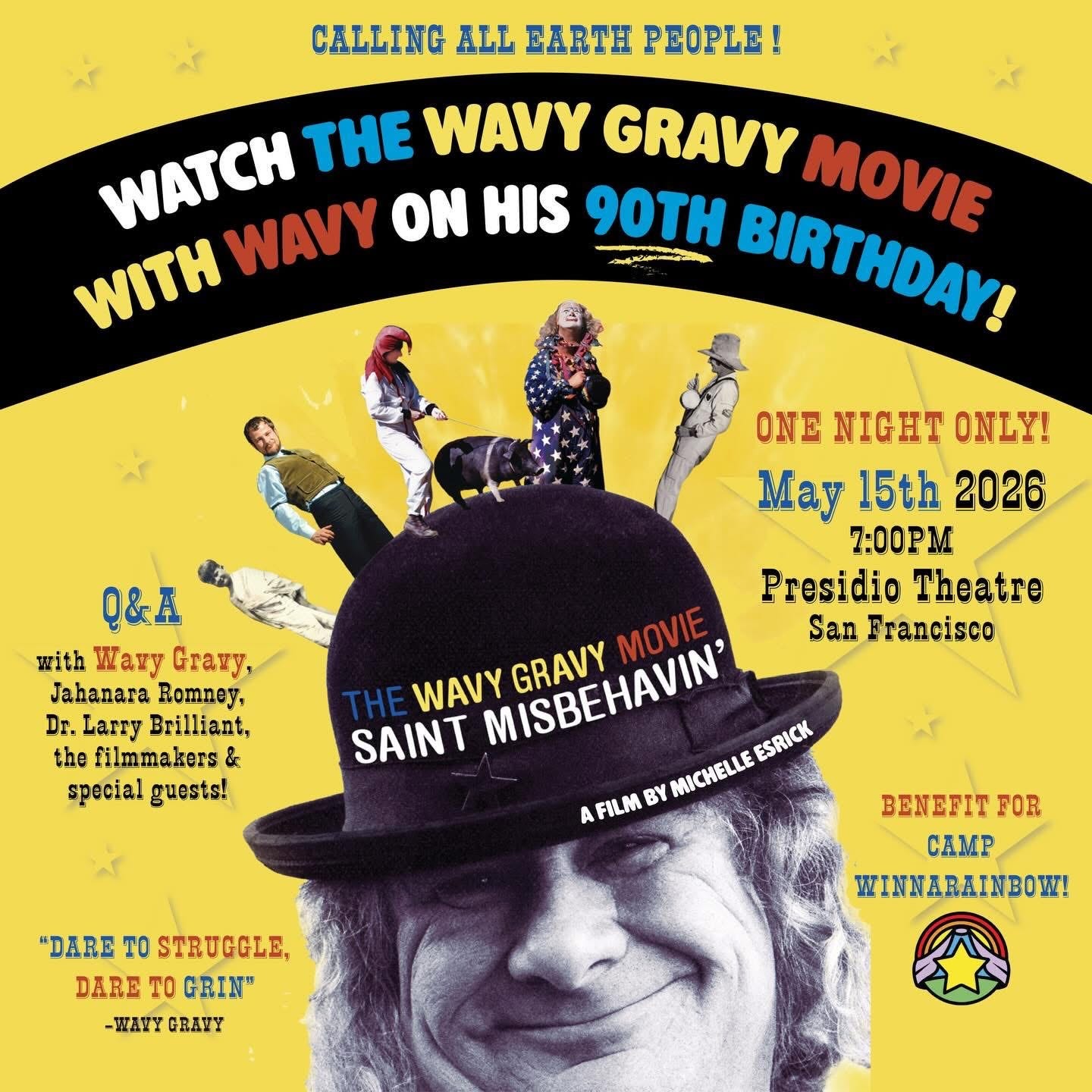
Wavy remains a board member and tireless fundraiser. His birthday benefits have become Seva traditions—raising millions over decades. The May 16, 2026 concert at The Masonic in San Francisco (right after the Presidio Theater film screening you shared) continues that legacy, with Steve Earle, Todd Rundgren, and others performing to support Seva and Camp Winnarainbow.
Seva’s story proves that blending counterculture heart, scientific rigor, and local empowerment can create one of the most effective global health models. It’s not charity—it’s justice through sight.
Didn't Wavy Gravy and Ram Das run “Nobody” for president back in the 60’s or 70’s?
Nobody cares. Nobody in their right mind would run for president etc…