
A Move Toward Wholeness
A little later in the morning.

Slip Kid
I had thought I hadn’t written on the subject of “Slip Kid” by the Who yesterday, but then discovered that I have:

Entwistle’s “connect the dots” illustration for the cover of The Who By Numbers leaves it to us to make the Who whole. So many layers invite us into this exploration. The line that strikes me most strongly today is:
“Slip over here and set me free!”
I equate this with “make me whole” and now the idea of the shout of “make a hole!” within a crowd as people are exhorted to clear the way for the passage of someone who might need to get through…am I getting through? I never know.
Now I’m listening to:
This is a direct reference to Townshend’s devotion to Meher Baba. Any observant soul here on Substack will know that I’m regularly amplifying the signal from Meher Baba. For example, here’s what Meher Baba had to say about miracles. That leads me right here:
There’s a great irony in this one1, I feel, but we are all quite miraculous - our very existence in time is - and it fills me with doubt as I observe us making our way from dawn to dusk. Earlier today, I was solidly on this beam:
Morning in the Bunker

A couple of evenings ago, after having a call over Zoom with Break Free With Me (Mac) in preparation for an eventual appearance on his Substack, I wrote:
As luck would have it, the pleroma then served up Three of a Perfect Pair which is a reference both to the title track and the fact that the 1980’s King Crimson was contractually obligated to produce a third album to follow up on 1981’s Discipline and 1982’s Beat. Therefore, in 1984, this:
I used “Model Man” as the title for an essay on my late father:
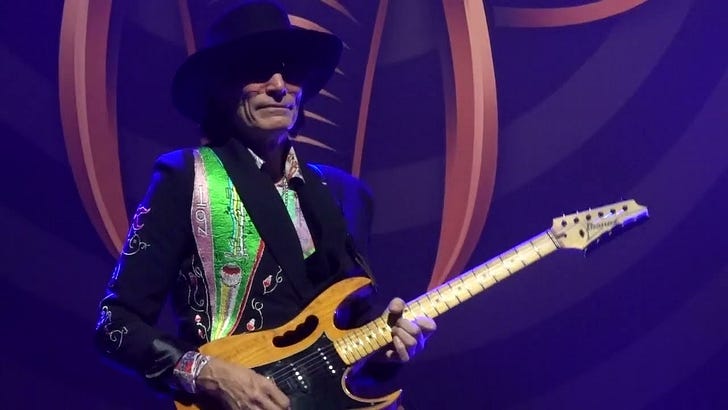
It leads off with the band, Beat, playing “Model Man” and then talks extensively about my father’s life. Beat is now in Europe touring through the summer. Catch them if you can! The post, as you can see, dates from very early in the history of the Harold B Gill Foundation, LLC.
Harold B. Gill, Jr.
My father may not have been a “model man” but he was the very model of a modern research historian of the highest level. He dug into primary source materials to put flesh on the bones of those who made my hometown’s history between 1632 and 1800 or so:
Putting Flesh on the Bones
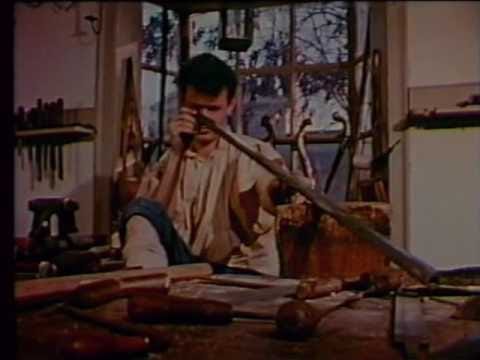
The Harold B Gill Foundation preserves the work of my late father who really did put “flesh on the bones” of those who left few marks on history in terms of biography - but who, as ordinary people of the 18th century colony of Virginia were instrumental in keeping the wheels of commerce turning - just as we in the 21st century are doing with every cent …
The image that graces the link here is from the film “The Gunsmith of Williamsburg” which starred a young Wallace Gusler. Together, my father and Wallace helped to shape what is known about the history of Virginia Furniture. Wallace was good enough to mention Dad’s influence in an article in one of the magazine’s dedicated to muzzle-loading firearms just before Dad passed away. I was digging for that article but came up with this one instead:
https://research.colonialwilliamsburg.org/foundation/journal/Autumn00/gunsmith.cfm
It’s worth the price of admission, having come out just about the time that I left the Conservation Department at the Carnegie Museum of Art bound for a new career in Copenhagen, Denmark. It’s funny how life meshes things together. Wallace was an artist of the first degree and after a tenure as curator of furniture at Colonial Williamsburg, he became the Director of Conservation. During his tenure, I became a Conservation Technician which, after earning my MA in German at Pitt, found me returning to that field in Pittsburgh. One thing leads to another, as I like to say. By my fireplace, there’s an 18th century sword that Wallace gave to Dad as a “thank you” for many hours of consultation and consolation as Wallace went through his divorce from his first wife. I remember well that Wallace recommended “Desolation Row” by Bob Dylan to me during that time:
The first line of this tune refers to Postcards of the Hanging, which is also the title of a compilation produced by David Gans. David was a guest here on the Harrowings Podcast not too long ago:
This is actually my seventh-most popular video on YouTube, as it turns out. Sunny Trippel joined me in this interview. I’m so grateful for my friends on this plane.
So, I’m beginning to wander a bit. I think it’s time to revisit the beginning of the post and find out where I had intended to go!
Come Ride The Music - To Wholeness
That’s where I was heading. After talking this morning about sexuality and how we humans are fragmented by the things that we don’t embrace culturally speaking, I began to have voices echo in my head and presently, the late Marty Balin’s refrain from “Wooden Ships”
The whole album, Volunteers, should be heard if you haven’t already experienced it:
I’ll leave it to you to unpack it, but it is rich and full of timely suggestions for humanity.
Harrowings follows along in the same spirit as the Jefferson Airplane. It (I) do all I can to support those who are still in the game. I like to remind myself that this life is a voyage to wholeness, toward reintegration of the Self with the All. I could go on and often do, but for now, let this suffice.
If you are inspired to say anything as result on going through this little trip with me, please do:
We are not us without you. Onward!
…and, as always, please:
Click a button! Any button…
The Legend of “Miracles” (1975): Irv Cox was hired as a guest session musician for Jefferson Starship’s Red Octopus album. According to firsthand accounts from musicians who met him later, Cox laid down his iconic, passionately smooth saxophone solo on the track “Miracles” on the very first take. The band was so impressed they immediately accepted it, thanked him, and wrapped up his session. [1]
I like this quote, Hal: "this life is a voyage to wholeness, toward reintegration of the Self with the All". To me the interesting part, and how it looks from my horizon, is that we never stopped being integrated with the All, and we never stopped being whole. The journey is about founding that out, living it, expressing it. Love, Maria